



Scriptures, unless otherwise indicated, are taken from THE HOLY BIBLE, NEW INTERNATIONAL VERSION®, NIV® Copyright © 1973, 1978, 1984, 2011 by Biblica, Inc.® Used by permission. All rights reserved worldwide. Scriptures indicated NASB are taken from the NEW AMERICAN STANDARD BIBLE®, Copyright © 1960,1962,1963,1968,1971,1972,1973,1975,1977,1995 by The Lockman Foundation. Used by permission. Scripture quotations marked (NLT) are taken from the Holy Bible, New Living Translation, copyright © 1996, 2004, 2007 by Tyndale House Foundation. Used by permission of Tyndale House Publishers, Inc., Carol Stream, Illinois 60188. All rights reserved. Scripture quotations marked HCSB are taken from the Holman Christian Standard Bible®, Copyright © 1999, 2000, 2002, 2003, 2009 by Holman Bible Publishers. Used by permission. Holman Christian Standard Bible®, Holman CSB®, and HCSB® are federally registered trademarks of Holman Bible Publishers. Wherever indicated NCV, scripture taken from the New Century Version®. Copyright © 2005 by Thomas Nelson, Inc. Used by permission. All rights reserved.
The Great Apostasy
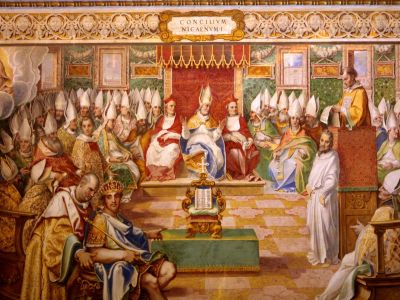
The New Testament gives serious warnings about drift after the Apostles. Paul cautions that “savage wolves” can arise even “from among your own selves,” drawing disciples after themselves. This article explores one way Christians have described that long drift: a “Great Apostasy” (2 Thessalonians 2:3) in which the Jesus movement, once a minority faith, learned to speak in the categories of public institutions and philosophical schools as it moved into the orbit of Roman power. The aim is not to question the sincerity of believers, but to trace how those pressures reshaped Christian language over time, and to invite a return to Scripture’s own horizon of resurrection, restored creation, and God’s Kingdom on earth.