

Science is a way of studying how the universe works through careful observation, measurement, and testing of ideas. It keeps asking, “How do things behave?” and stays open to correction as new evidence comes in.
Ancient sacred texts, including the Bible, are not physics or biology textbooks. They speak first about God, justice, worship, and human life. Yet they also describe the created world, the earth, sea, stars, rain, and human bodies. It is worth asking how those descriptions sit alongside what we have learned through modern science.
Most of the biblical books quoted below were written or compiled between roughly 1400 and 400 BCE, across many centuries of empire, from Egypt and Assyria to Babylon and Persia.1 In many surrounding cultures, sun, moon, stars, and seas were worshiped as gods that backed the king’s rule. By insisting that one Creator made and governs all these powers, the Bible quietly challenges imperial superstition and points toward a different kind of rule: the Kingdom of God, grounded not in fear and domination but in justice, mercy, and care for creation.
This article does not try to force the Bible to “prove” itself by meeting modern scientific standards. Instead, it simply notices several places where biblical language about creation sits comfortably within the broad picture that science has uncovered. That coherence does not replace faith, but it can encourage thoughtful readers who wonder whether the God of the Bible can also be the God of quarks, galaxies, and gravitational waves.
This exploration assumes that honest scientific work is one way of listening to how God’s world actually works. It is not anti-science; it is an invitation to bring Scripture and creation into conversation.
It is also important to say that the Bible does not describe everything as if it were part of the everyday laws of nature. Alongside its regular language about seasons, winds, and oceans, Scripture also records events it clearly treats as miracles: healings, signs, and interventions that are presented as special acts of God rather than the normal state of the world. Those stories belong more to the Bible’s claim about God’s freedom and faithfulness than to a catalogue of routine physical processes.
Sometimes, as history moves on, things that once looked mysterious or “magical” turn out to have an ordinary explanation we simply did not know yet. At other times, the Bible is making a theological claim that God has done something above and beyond the patterns we can measure. This article focuses on the places where Scripture speaks about the regular behavior of creation, the part of God’s world that science is designed to study, while leaving room for God’s freedom to act in ways we cannot reduce to our current theories.
Where Is the Earth, and How Does It Look?
Ancient peoples pictured the earth in many different ways, sometimes as a disk resting on pillars, sometimes as a flat land surrounded by cosmic waters. The Bible uses a variety of poetic images as well, yet one striking line stands out.
- Around 3,000 years ago (late first millennium BCE), the book of Job poetically declared, “He [God] suspends the earth over nothing” (Job 26:7).
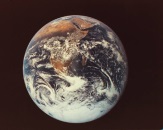
From our vantage point in space, the earth really does appear to “hang” in the darkness, held in orbit not by visible pillars but by invisible gravity. Job is not giving a physics lesson, but its picture of earth “over nothing” fits surprisingly well with what later generations would see from orbit.
The Bible also includes language that treats the earth as a circle with depth. Isaiah speaks of God as the one who sits “above the circle of the earth” (Isaiah 40:22), a book often dated to the 8th century BCE, and Proverbs says God “inscribed a circle on the face of the deep” (Proverbs 8:27), language linked to royal wisdom traditions from the time of Solomon. These are poetic images, not technical geometry, but they sit comfortably with a world that is spherical rather than an endless flat plain.
Greek thinkers such as Pythagoras and later Eratosthenes would explore the earth’s curvature in more mathematical ways, and explorers in the 16th century would sail all the way around the globe. The Bible’s poetic “circle” language belongs to a much earlier era, but it does not resist this growing understanding; it easily fits within it.
Sun, Moon, Stars, and Signs in the Sky
In many ancient empires, the sun, moon, and stars were feared and worshiped as living deities. Rulers claimed these heavenly beings backed their power. An eclipse or comet could be read as a terrifying omen for the king or his enemies.
By contrast, the first chapter of the Bible simply says that God made the greater and lesser lights and the stars (Genesis 1). In the Torah’s final form (likely complete by the 5th century BCE), these heavenly bodies are not rival gods. They are created lights that mark times and seasons, part of an ordered creation rather than beings to be appeased.
Centuries later, around the late 7th-early 6th century BCE, the prophet Jeremiah relayed this warning: “Do not be terrified by signs in the heavens though the nations are terrified by them” (Jeremiah 10:2). Eclipses and unusual events in the sky may still catch our attention, but the Bible insists they are not monsters devouring the sun or omens that overthrow God’s purposes.
Modern astronomy has shown that the sun is a star, the moon a rocky satellite, and eclipses the result of ordinary orbital alignments. The Bible, long before such calculations were possible, already encouraged people not to be enslaved by fear of the sky, but to trust the Creator who made and sustains it.
Valleys and Mountains in the Sea
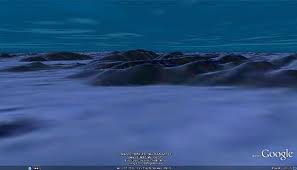
For a long time, many people assumed the ocean floor was mostly flat and sandy, like a giant basin. Detailed maps of the deep ocean are a very recent achievement, made possible only with modern ships, sonar, and satellites. They reveal dramatic trenches and long undersea mountain ranges that rival anything on land.2
Israel’s hymnbook, the Psalms, composed and compiled between roughly 1000 and 400 BCE, uses language of the “valleys of the sea” (Psalm 18:15 NIV; echoed in 2 Samuel 22:16). The book of Job asks, “Have you walked in the recesses of the sea?” (Job 38:16). And the story of Jonah, likely written in the post-exilic period centuries before Christ, has the prophet describe sinking to the “roots of the mountains” in the sea (Jonah 2:6 NIV).
These texts are poetic and prayerful, not deep-sea surveys. They do not give measurements or cross-sections. Yet they speak naturally of valleys and mountain roots beneath the waves, a way of imagining the sea that aligns well with the complex landscapes modern oceanographers have now mapped.
Paths of the Sea: Ocean Currents
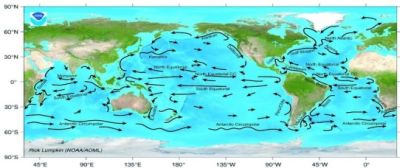
The 19th-century U.S. naval officer Matthew Fontaine Maury loved both the sea and the Bible. While reading Psalm 8, he noticed the phrase about creatures that move through the “paths of the sea” (Psalm 8:8). That phrase helped spur his curiosity about whether the oceans might have regular, map-able currents.
Maury went on to gather ship logs and observations from captains around the world. From this data he charted major ocean currents and wind patterns and published some of the first systematic atlases of the oceans. He became known as the “Pathfinder of the Seas” and a founder of modern oceanography.3
The psalmist who wrote about “paths of the sea” probably never saw an ocean map. Yet the phrase captures something real about the way water moves through deep, steady currents – highways in the sea that fishing boats, cargo ships, and climate scientists now take very seriously.
Rain, Lightning, and the Water Cycle

Across cultures, people invented many stories to explain lightning, thunder, and rain. The Bible also speaks of storms with vivid imagery, but it repeatedly emphasizes that creation follows patterns and rhythms set by God:
“While the earth remains, seedtime and harvest, and cold and heat, and summer and winter, and day and night shall not cease” (Genesis 8:22).
Job says that God “made a decree [rules] for the rain” (Job 28:26). Other passages describe those rules i.e. what we now call the water cycle. The 8th century BCE prophet Amos writes, “He [God] calls for the water of the sea and pours them out over the face of the land” (Amos 9:6). Job describes how God “draws up the drops of water, they distill rain from the mist, which the clouds pour down” and “drip upon man abundantly” (Job 36:27–28).

These ancient texts speak of evaporation from the sea, cloud formation, and rain returning to the land. The picture is still poetic and unsystematic, but the basic cycle of water rising from the sea and falling again as rain is recognizable. The details of the hydrologic cycle were only gradually recognized and quantified in early modern science.4
Star Systems: Pleiades, Orion, and Arcturus
Near the end of the book of Job, God challenges Job with questions about the heavens:
“Canst thou bind the sweet influences of Pleiades, or loose the bands of Orion? Canst thou guide Arcturus with his sons?” (Job 38:31–32).
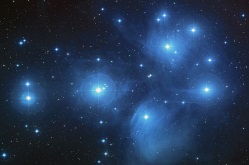
The Pleiades is an open star cluster in the constellation Taurus, containing hundreds of stars that move together through space, loosely bound by gravity.5 Early in the 20th century, astronomer Robert J. Trumpler described them as a group of suns traveling together, saying they “may thus be compared to a swarm of birds, flying together to a distant goal.” That image fits Job’s question about a cluster whose “sweet influences” are held together in a common motion.
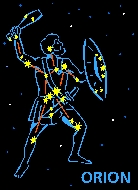
The stars of Orion, by contrast, are not a single bound cluster. Astronomers have noted that the famous three-star “belt” will slowly change shape over vast periods of time as the stars move on different paths. Early-20th century astronomer Garrett P. Serviss, in Curiosities of the Sky, described how the “band” of Orion’s belt will eventually be loosed as one star drifts away from the others.6 Job’s question about “loosing the bands of Orion” resonates strikingly with that modern picture.
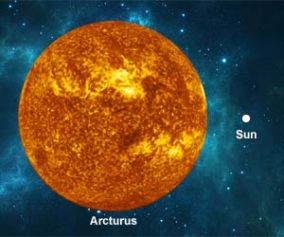
Arcturus, a bright orange star in the constellation Boötes, is one of the closest and most luminous stars in our sky. Modern measurements show that it has a very high proper motion and speed relative to our solar system, far higher than many neighboring stars, leading some astronomers to describe it as a kind of “runaway” star, not easily held by the combined pull of other stars.7 When Job asks, “Can you guide Arcturus with his sons?” the implied answer is no: it is beyond human control, part of a vast cosmos that only God truly governs.
Early-20th century astronomer Charles Burckhalter, director of the Chabot Observatory in California, was struck by how these ancient verses in Job lined up with what his generation was learning about the stars. After studying the text alongside recent discoveries, he concluded that “the Bible is an inspired book and was written by the One who made the stars.”8 His conviction does not replace careful science, but it shows how a working astronomer could see his own data as deepening, rather than weakening, trust in the biblical Creator.
Health, Disease, and Ordered Care for Life
Some of the Bible’s most practical-sounding instructions also touch on areas that later became formal scientific disciplines. Israel’s laws about isolation, washing, and blood were given in a context of worship and community health, not laboratory science, but many of them have clear public-health value.
Leviticus includes instructions to wash with running water in certain cases of bodily discharge (Leviticus 15:13) and to separate those with visible skin diseases from the camp (Leviticus 13). Centuries later, the idea of quarantine as a systematic public-health tool developed in Europe during plague outbreaks in the late Middle Ages.9 In the 19th century, physicians such as Ignaz Semmelweis showed how handwashing could dramatically reduce deaths from infection, especially in childbirth.10 Before such insights, it was common for doctors to rinse their hands in a shared bowl of still water or to move from patient to patient without washing, allowing infection to spread rather than be removed.10
Leviticus also says, “the life of a creature is in the blood” (Leviticus 17:11). Today we know that blood carries oxygen, nutrients, hormones, and immune cells throughout the body. Again, the Bible is not a medical textbook, but its language honors blood as a vital carrier of life rather than a mere fluid to be casually drained. By contrast, for centuries many physicians practiced routine “bloodletting” as a treatment, a method that often weakened patients and was gradually abandoned as knowledge of circulation and infection improved.10
A Note on the “Days” of Genesis
Some readers assume that Genesis 1 teaches that everything was created in six 24-hour days. But the chapter itself marks the sun and moon, which mark literal days and nights for us, as appearing only on the “fourth day.” This already suggests that its “days” function more like ordered stages in a liturgical or narrative pattern than like timestamps on a stopwatch. Genesis 1’s main claim is that the one Creator brings order out of chaos and fills the world with life, not that every species was made in its final form all at once. Therefore Genesis could be seen through a lens compatible with an evolutionary history for plants and animals, while still affirming that human beings have a higher consciousness, a unique calling and accountability before God. That larger conversation about Genesis and evolution is important, but it lies beyond this brief article.
The Ancient Bible and Science: A Summary
The Bible’s primary purpose is to tell the story of God, God’s people, and God’s purposes in history. It’s not offering a full scientific model of the universe. Even so, many of its ways of speaking about creation sit comfortably with what later generations have discovered. The table below gathers some of the examples mentioned above.
| Topic | Biblical language | Modern scientific picture |
|---|---|---|
| Earth | Creation begins “formless and empty,” with darkness over the deep (Genesis 1:2). | Planets form gradually from gas and dust, moving from chaos toward structure. |
| God sits above the “circle of the earth” and inscribes “a circle on the face of the deep” (Isaiah 40:22; Proverbs 8:27). | Earth is a finite globe with measurable curvature, not an endless flat expanse. | |
| “He [God] suspends the earth over nothing” (Job 26:7 NIV). | Earth orbits in space, held by gravity rather than resting on visible pillars. | |
| Stars | The stars cannot be counted (Jeremiah 33:22). | Modern astronomy sees hundreds of billions of stars per galaxy and billions of galaxies. |
| “Star differs from star in glory” (1 Corinthians 15:41). | Stars vary widely in brightness, color, mass, and lifespan. | |
| Atoms | “What is seen was not made out of what was visible” (Hebrews 11:3). | Visible objects are made of atoms and smaller particles that cannot be seen with the naked eye. |
| Light and air | Light has a “way” and is “parted” (Job 38:19–20, 24). | Light travels along paths and can be split into colors (for example, by a prism). |
| God gives “weight to the wind” (Job 28:25 NIV). | Air has mass and pressure; changes in pressure drive winds and weather. | |
| Wind and rain | The wind has “circuits” (Ecclesiastes 1:6). | Global wind patterns circulate around the planet, shaping climate zones. |
| God “draws up the drops of water” and clouds “pour down” rain (Job 36:27–28; Amos 9:6). | The water cycle moves water through evaporation, clouds, and precipitation. | |
| Ocean | Speaks of “valleys of the sea” and “recesses of the deep” (Psalm 18:15; Job 38:16; Jonah 2:6). | Mapping reveals deep trenches and long undersea mountain chains. |
| Mentions “springs of the sea” (Job 38:16). | Scientists have found seafloor springs and hydrothermal vents where water flows from beneath the seabed.2 | |
| Health | Instructions to wash in running water and to isolate certain diseases (Leviticus 13; 15:13). | Running water and quarantine reduce the spread of infection; shared basins and poor hygiene can spread disease.10 |
| Blood | “The life of a creature is in the blood” (Leviticus 17:11). | Blood is essential for carrying oxygen, nutrients, and immune cells; older bloodletting practices often harmed patients.10 |
Conclusion: Who Is the God of Science?
These examples do not prove in a mathematical way that the Bible is inspired. They do show that when the Bible speaks about creation, it does so in ways that often fit remarkably well with the broad patterns later explored by science. Instead of depicting a universe ruled by many rival gods who back competing empires, Scripture presents one Creator who calls the stars by name, sets bounds for the sea, and cares about the health of ordinary people.
The Bible claims that this same Creator desires to establish a just and healing Kingdom through Jesus Christ, a Kingdom that will one day renew the whole creation. It says its prophets were “carried along by the Holy Spirit” (2 Peter 1:21), and that promise is not just about accurate statements but about a trustworthy story: the story of the God of all creation, inviting us into wisdom, humility, and hope.
Read next — The Test of History
Footnotes
- These dates are rough ranges rather than exact years. For an accessible overview of how the Old Testament took shape over many centuries, see, for example, “The History of the Bible” at Christianity.org.uk. ↩
- On ocean trenches, undersea mountains, and seafloor features such as hydrothermal vents and springs, see educational resources from the U.S. National Oceanic and Atmospheric Administration (NOAA), such as “Ocean floor features” at noaa.gov. ↩
- On Matthew Fontaine Maury, his use of ship logs, and his nickname “Pathfinder of the Seas,” see the U.S. Navy biography “Matthew Fontaine Maury (1806–1873)” at history.navy.mil. ↩
- For a brief history of how the hydrologic cycle came to be described scientifically, see standard overviews of hydrology such as the article “Hydrology” at en.wikipedia.org, which summarizes contributions from figures like Bernard Palissy, Pierre Perrault, and Edmond Halley. ↩
- On the Pleiades (Messier 45) as an open star cluster whose stars are loosely bound by gravity and move together through space, see NASA’s Messier catalog entry “Messier 45 (The Pleiades)” at science.nasa.gov. For an early-20th-century description by Lick Observatory astronomer Robert J. Trumpler comparing the Pleiades to “a swarm of birds, flying together to a distant goal,” see reproductions of his remarks in resources such as the booklet “Fascinating Facts for Bible Students” (Chicago Bible Students), available as a PDF at chicagobible.org. ↩
- Garrett P. Serviss discusses the changing shape of Orion’s belt in his early-20th-century popular astronomy book Curiosities of the Sky, available in the public domain via Project Gutenberg at gutenberg.org. ↩
- On Arcturus, its brightness, and its unusually large proper motion, see resources such as the EarthSky article “Arcturus, the brightest star of the northern sky” at earthsky.org and background from encyclopedic entries like “Arcturus” at en.wikipedia.org. ↩
- For Charles Burckhalter’s reflection that the study of Job and modern astronomy led him to the “matured conviction that the Bible is an inspired book and was written by the One who made the stars,” see reprints of his statement in compilations such as “Scientific Facts in the Bible” (Logan Christian Fellowship PDF) at loganchristianfellowship.com or similar collections. ↩
- On the development of quarantine as a public-health measure in late-medieval Europe and beyond, see historical surveys such as “History of quarantine” from the U.S. Centers for Disease Control and Prevention at stacks.cdc.gov. ↩
- For Ignaz Semmelweis and the role of handwashing in preventing childbed fever, see biographical treatments such as “Ignaz Semmelweis” from the Science History Institute at sciencehistory.org or the PBS feature “In 1850, Ignaz Semmelweis saved lives with three words: wash your hands” at pbs.org. For broader background on older practices such as basin handwashing and bloodletting, see standard histories of medicine and exhibits from institutions like the U.S. National Library of Medicine. ↩




Amazing!
I am always looking for these sorts of article detailed information about animals should be discussed. I really appreciate your work and I also share it to my friends.
Thank God
Amen
I am
Exodus 3:14
தேவன் ஒருவரே படைப்பாளி amen
There is a vast diffetance between a circle and a sphere.. A circle can also be flat. To use the word planet is unlearned… The proper translation is wandering stars question… Why are all the dark spots on the moon named after Jesuits. . Why does God declare the heavens are for him alone .. but man like the fallen one is trying tobget up there. I think this needs to be revised.