

The God Who Claims to Tell History in Advance
The Bible introduces the God of Israel as the one who not only walks with people in their present but also claims to announce key events of history ahead of time. In Isaiah we hear this bold challenge:
“I declared the former things long ago and they went forth from My mouth, and I proclaimed them.
Suddenly I acted, and they came to pass… Therefore I declared them to you long ago, Before they took place I proclaimed them to you, So that you would not say, ‘My idol has done them, and my graven image and my molten image have commanded them’” (Isaiah 48:3,5).
Here, Israel’s God stakes a claim: if anyone is truly God, that God must be able to hold history, confront idols, and comfort people living under the pressure of empires.[1] For many readers, fulfilled prophecy looks like a direct test of that claim. Yet as soon as we start to trace specific examples, another question arises: how were these prophetic books written, edited, and heard in real historical time, especially under imperial rule?[2]
Prophecy in the Bible: More Than Fortune-Telling
The Bible is unusual among religious texts in how centrally it places prophetic speech. Roughly a third of its chapters contain some form of prophecy or apocalyptic vision, depending on how one counts.[3] These texts speak of the rise and fall of cities, empires, and rulers; they also call ordinary people to repent, practice justice, and resist idolatry.
In popular apologetic books, fulfilled prophecy is often presented in a simple way: “If the predictions came true in detail, then the Bible must be God’s written word, and God must be directing human history.” That instinct can flatten the complexity of how these texts came to us. Biblical prophecy is not merely a list of advance newspaper headlines; it is also poetry, lament, and resistance literature voiced by communities under empire.[4]
So as we look at some well-known examples, we will keep two truths alongside each other:
- The Bible’s own storyline presents God as the one who can “declare the end from the beginning” (Isaiah 46:9–10).
- Many scholars, especially in historical-critical and empire-critical traditions, argue that some “prophecies” were written or edited after the events they describe, retro-fitting history into prophetic speech as a way of protesting imperial power and sustaining hope.[5]
Empires on the Map: Assyria, Babylon, Persia, Greece
Several biblical passages speak of specific empires and their actions. The following table summarizes a few often-cited examples from the Old Testament prophets and the book of Daniel:
| Predicted | 732 BCE | Assyria will conquer Egypt and Ethiopia (Isaiah 20:3–5). |
| Fulfilled | 673–670 BCE | Assyria campaigns into northeast Africa and dominates Egypt and Cush.[18] |
| Predicted | 701 BCE | The Babylonian Empire will take Judah into exile (Isaiah 39). |
| Fulfilled | 597 BCE; 586 BCE | Babylon deports leading Judeans and destroys Jerusalem and its temple.[19] |
| Predicted | 732 BCE | The Medo-Persian Empire will conquer Babylon (Isaiah 13:17–20), and Babylon will become a desolate site. |
| Fulfilled | 538 BCE; later centuries | Persia captures Babylon; over time the ancient city falls into ruin and never again becomes a major imperial capital, though nearby areas remain inhabited.[20] |
| Predicted | c. 6th–2nd cent. BCE (as narrated) | A powerful Greek king will overthrow Persia, and his kingdom will be divided rather than passed intact to his heirs (Daniel 8; 11). |
| Fulfilled | 330–281 BCE | Alexander the Great conquers Persia; after his death, his generals divide the empire and his heirs are sidelined.[21] |
Readers who trust the Bible as God’s word see in such patterns strong evidence that God directs human history, not the idols of empire. At the same time, many historians and biblical scholars suggest that at least some of these passages, especially in Daniel, were composed or given their final shape after the events they “predict,” turning remembered history into prophecy as a way of naming and resisting imperial violence in coded form.[6] In other words, they function as counter-imperial texts that expose the limits of human empires and call God’s people to endurance.
Holding both angles together can be spiritually honest. For faith, the question is not only “How early was this prediction written?” but also “What does this text reveal about God’s character and about the empires it critiques?”[7]
Cities That Rise and Fall: Tyre and Sidon
Tyre: Commercial Superpower Under Judgment
Ezekiel 26:1–14 contains a famous oracle against Tyre, a powerful trading city whose influence stretched across the Mediterranean. The prophecy makes a series of specific claims:
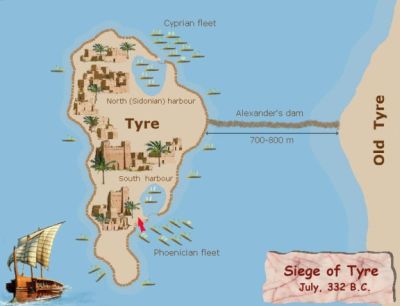
- Many nations will come against Tyre (Ezekiel 26:3).
- Nebuchadnezzar will lay siege to and devastate the mainland city (Ezekiel 26:7–11).
- The city’s rubble will be thrown into the sea (Ezekiel 26:12).
- The site will be scraped bare like a rock (Ezekiel 26:4,12).
- Fishermen will spread their nets over the ruins (Ezekiel 26:5).
- The old Tyre will not be rebuilt in its former glory (Ezekiel 26:14).
Historically, Nebuchadnezzar did besiege and subdue the mainland city. Many inhabitants retreated to the island about a third of a mile offshore. Two centuries later Alexander the Great famously demolished the old mainland site and used its stones and dust to build a causeway to the island, scraping the area down to bedrock in the process.[8] Over subsequent centuries, Tyre was repeatedly attacked by different empires and eventually reduced in importance. Today, the ancient mainland site is largely a place of ruins and fishing activity, while a modern town exists nearby.
Here again, some readers see striking advance prediction, while others see a powerful theological interpretation of events that were already unfolding. Either way, the prophetic point remains: commercial empires that enrich a few at the expense of many are not permanent. They can be judged, dismantled, and remembered only as places “for the spreading of nets in the midst of the sea.”
Sidon: Wounded but Not Erased
Sidon, Tyre’s sister city, receives a different word. Ezekiel speaks of blood in its streets, wounded falling in its midst, and the sword on every side (Ezekiel 28:22–23), but not of total annihilation.
- Sidon would face repeated violence and war.
- Unlike Tyre, it was not destined to disappear completely.
Historical records suggest that Sidon indeed suffered multiple sieges, massacres, and fires across the centuries, yet the city survived in some form and is still inhabited today.[9] The contrast between Tyre and Sidon reminds us that prophetic speech is not a one-size-fits-all curse on “the world,” but a textured word to particular places and powers.
Messianic Hope: Prophecies about Jesus
The Old Testament is also shot through with promises of a coming anointed one, a Messiah, through whom God will rescue and renew his people. Followers of Jesus have long read many texts as pointing forward to him. Popular Christian writers sometimes count “over 300 prophecies” that Jesus fulfills, though such counts depend on how one defines a prophecy and a fulfillment.[10]
Two examples often cited are:
• His birthplace. Some seven centuries before Jesus, the prophet Micah named a small town in Judah as the place from which God’s ruler would come: “But as for you, Bethlehem Ephrathah, too little to be among the clans of Judah, from you One will go forth for Me to be ruler in Israel” (Micah 5:2). The Gospel according to Matthew presents Jesus as born in Bethlehem, in continuity with this hope.[11]
• His resurrection hope. About a thousand years before Jesus, David prays in Psalm 16: “You will not abandon me to the grave, nor will you let your Holy One see decay” (Psalm 16:10 NIV). The earliest Christian preaching in Acts reads this Psalm as a hint of the Messiah’s resurrection, fulfilled in Jesus.

The table below gathers a sample of traditional “prediction-fulfillment” pairings that many readers find meaningful:
| Event in the life of Jesus | Prophesied | Fulfilled |
|---|---|---|
| Born of a virgin | Isaiah 7:14 | Matthew 1:18,24–25 |
| Descendant of Abraham | Genesis 22:18 | Luke 3:34 |
| Teacher of parables | Psalm 78:2 | Matthew 13:34 |
| Betrayed by a close friend | Psalm 41:9 | Matthew 10:4 |
| Silent before his accusers | Psalm 35:11 | Matthew 27:12 |
| Wounded and bruised | Isaiah 53:5 | Matthew 27:26 |
| Smitten and spit upon | Isaiah 50:6 | Matthew 26:67 |
| Crucified with thieves | Isaiah 53:12 | Matthew 27:38 |
| Hated without a cause | Psalm 69:4 | John 15:25 |
| Onlookers scornfully shake their heads | Psalm 109:25 | Matthew 27:39 |
| Clothes divided and lots cast | Psalm 22:18 | John 19:23–24 |
| To suffer thirst | Psalm 22:15 | John 19:28 |
| Offered gall and vinegar | Psalm 69:21 | Matthew 27:34 |
| Side pierced | Zechariah 12:10 | John 19:34 |
| Commends his spirit to God | Psalm 31:5 | Luke 23:46 |
| Bones not broken | Psalm 34:20 | John 19:33 |
| Buried in a rich man’s tomb | Isaiah 53:9 | Matthew 27:57–60 |
| Darkness over the land | Amos 8:9 | Matthew 27:45 |
Some modern readers are persuaded by the sheer pattern; others point out that the Gospel writers themselves are consciously shaping their stories in conversation with Israel’s Scriptures, framing Jesus’ life as the climax of Israel’s long, counter-imperial hope.[12] That is, the New Testament often reads the Old Testament not simply as a set of predictions, but as a script and vocabulary that make sense of Jesus’ suffering love in a world dominated by Rome.
Prophecies and the Roman Empire
The New Testament itself contains prophetic material, particularly in Jesus’ teaching about Jerusalem and the temple. One striking example comes from Luke 21:
| Prophecies (c. 30–33 CE) | Fulfilments (70 CE and after) |
|---|---|
| Jesus foretells that Herod’s Temple will be destroyed stone by stone (Luke 21:5–6). | Roman armies under Titus destroy the temple in 70 CE.[22] |
| Jesus warns disciples to flee when they see Jerusalem surrounded by armies: “When you see Jerusalem being surrounded by armies, you will know that its desolation is near. Then let those who are in Judea flee to the mountains, let those in the city get out, and let those in the country not enter the city” (Luke 21:20–21 NIV). | In the late 60s, Roman forces under Vespasian surround much of Judea. When Nero dies, Vespasian returns to Rome; later traditions remember believers escaping before the final siege, while Titus’ forces ultimately destroy Jerusalem in 70 CE.[13] |
| Jesus speaks of catastrophic suffering and dispersion: “For these be the days of vengeance, that all things which are written may be fulfilled. But woe unto them that are with child, and to them that give suck, in those days! for there shall be great distress in the land, and wrath upon this people. And they shall fall by the edge of the sword, and shall be led away captive into all nations: and Jerusalem shall be trodden down of the Gentiles, until the times of the Gentiles be fulfilled” (Luke 21:22–24). | Josephus describes enormous loss of life and mass enslavement during the Jewish–Roman war, with survivors scattered across the empire and Jerusalem under non-Jewish control for many centuries.[14] |
Some readers who trust Jesus’ words see here a sobering example of foreknowledge and care: he warns disciples not to be trapped in a patriotic last stand that would lead to unnecessary death.
Many scholars, however, date the Gospel according to Luke to the late first century and think that at least some of this discourse reflects early believers looking back on the trauma of 70 CE, remembering Jesus’ voice and framing that catastrophe as part of God’s larger dealing with empire.[15] Either way, the theological thrust remains deeply counter-imperial: Rome’s “days of vengeance” are not the last word, and God’s purposes for Israel and the nations extend beyond the crushing of one city.
How Should We Read These Prophecies Today?
At one level, the biblical writers themselves give us their answer. 2 Peter says:
“But know this first of all, that no prophecy of Scripture is a matter of one’s own interpretation, for no prophecy was ever made by an act of human will, but men moved by the Holy Spirit spoke from God” (2 Peter 1:20–21).
This is the faith-claim: prophecy is not just human guesswork. Yet the same passage insists that prophecy needs careful interpretation. Modern readers who want to take both the Bible and history seriously often try to hold several commitments together:
- Listening to the text as Scripture. For followers of Jesus, these books are part of a canon through which God still speaks, summoning people away from idols and into the life of the Kingdom.
- Listening to the text as history. Dating, authorship, and editing matter. Some oracles may speak ahead of events; others may re-narrate events that have already happened in a prophetic key. Both can be ways God comforts and challenges communities under empire.[16]
- Seeing their counter-imperial edge. Many prophecies unmask the economic extraction, military violence, and idolatrous boasting of empires like Egypt, Assyria, Babylon, Persia, Greece, and Rome, while sketching an alternative society marked by manna-sharing, Sabbath rest, and Jubilee restoration.[17]
In other words, biblical prophecy is not simply a set of predictions to “prove” that God exists. It is an invitation to trust a God who sides with the oppressed against empires, who calls for a new kind of economy and community, and who promises to heal creation.
Summary: God of History, God of the Kingdom
- We have seen how several biblical texts speak with striking specificity about empires, cities, and the life of Jesus. Many believers receive these as predictions fulfilled in history.
- We have also noted that a number of scholars read some of these passages as written or edited in light of events already experienced, turning memory into prophetic protest and hope in the face of imperial domination.
- Either way, the God of the Bible is portrayed as the architect of a very different future: not endless cycles of empire, but the Kingdom of God coming to earth, where exploitation, slavery, and death are replaced by justice, rest, and restoration.
In the previous section on science, we saw that modern scientific discovery often echoes claims the Bible made long ago about creation and the orderliness of the universe. Here we have seen that many of the documented events of human history are also woven into the Bible’s prophetic imagination. Together, these themes invite us to consider whether the God of the Bible truly is the God of history and the One in charge of humanity’s destiny.
Questions for Further Reflection
- If the God of the Bible is indeed our Creator and the One who holds history, what kind of God is he?
- Is he fair and just in the way he deals with empires, victims, and perpetrators?
- Does he care about the poor, the enslaved, the displaced, and the wounded, or only about abstract “plans”?
- If he is so powerful, why does he allow so much evil, and how do the prophets wrestle with that question?
- What is the future this God has promised for humanity and creation, and how does that relate to the “times of restoration of all things” announced in the Bible?
To explore those questions, continue with: Good News (For Real)
References
- Isaiah 40–48 stages repeated “trial scenes” where Israel’s God challenges idols to declare and interpret history, a literary way of asserting Yahweh’s uniqueness in a world of many gods. ↩
- Historical-critical readings relate such claims to concrete imperial settings, especially Neo-Assyrian and Neo-Babylonian domination, when questions about who truly rules history were painfully urgent. ↩
- Estimates that “about one third” of the Bible is prophetic depend on genre definitions but highlight how central prophecy and apocalyptic vision are within the canon. ↩
- Amos, Hosea, Isaiah, Jeremiah, and Ezekiel combine social criticism, poetic lament, and visions of future hope rather than functioning as mere lists of future events. ↩
- Ex eventu (“after the event”) prophecy describes how communities under oppression retell recent history in the form of divine prediction as a way of asserting that empires are not in ultimate control. ↩
- Daniel is a classic example: many interpreters date its final form to the time of Antiochus IV Epiphanes (2nd cent. BCE), reading its visions of beasts and kings as veiled critique of Hellenistic imperial power. ↩
- Even in conservative Christian scholarship, there is growing recognition that prophecy can be both genuinely revelatory and deeply embedded in human literary and historical processes. ↩
- For Alexander’s siege of Tyre and construction of the causeway, see Arrian, Anabasis of Alexander 2.17–24, English translation at Attalus. ↩
- For Sidon’s repeated sieges and its continued habitation, see the overview “Sidon” at Livius and the brief survey in “History of Sidon”. ↩
- Such counts often include typological parallels and broader thematic allusions, not only explicit predictive statements, which is why different authors arrive at different totals. ↩
- The New Testament’s use of Micah 5:2 reflects a larger pattern in which the evangelists read Israel’s Scriptures as a script into which Jesus’ life “fits,” rather than as a collection of isolated predictions. ↩
- In Matthew especially, fulfilment formulas (“that it might be fulfilled…”) function as theological commentary, signalling that Jesus embodies Israel’s story and vocation in a new way under Roman rule. ↩
- The “flight to Pella” tradition is reported by Eusebius, Ecclesiastical History 3.5, and discussed in accessible form in “The Christian Flight to Pella—True or Tale?” at Biblical Archaeology Review. ↩
- For the devastation of the Jewish–Roman war, see Josephus, Jewish War 5–6 (English translation at Project Gutenberg). Josephus’ casualty numbers are debated but illustrate the remembered scale of suffering. ↩
- Many New Testament introductions date Luke–Acts to the last decades of the first century CE, which would mean that its portrayal of Jesus’ predictions is shaped in conversation with the already-occurred destruction of Jerusalem. ↩
- For readers who hold to divine inspiration, the question “before or after the event?” does not exhaust the theological meaning of prophecy; God may work both through anticipatory oracles and through inspired re-reading of traumatic history. ↩
- Elsewhere on this site, the patterns of Joseph’s grain policies in Egypt, the manna regulations in the wilderness, the Sabbath command, and the Jubilee legislation are explored as anti-hoarding, anti-slavery practices that stand over against imperial economics and point toward God’s Kingdom on earth. ↩
- For Esarhaddon’s conquest of Egypt, see the royal inscription “Esarhaddon: The Conquest of Egypt” in translation at Livius. ↩
- The Babylonian Chronicle ABC 5 (“Jerusalem Chronicle”) refers to Nebuchadnezzar’s capture of Jerusalem in 597 BCE; translation at Livius. ↩
- For the Persian capture of Babylon in 539 BCE, see the Cyrus Cylinder and the Nabonidus Chronicle (ABC 7), both in translation at Livius and Livius. ↩
- On Alexander’s conquest of Persia and the division of his empire, see Arrian, Anabasis of Alexander (translation index at Attalus) and the “Diadochi Chronicle” (ABC 10) at Livius. ↩
- For the destruction of Herod’s Temple in 70 CE, see Josephus, Jewish War 6.4–6 (English translation at Project Gutenberg). ↩





1. Božja Zapovijest –
DA LI JE POŠTUJEŠ?
=================================
IZLAZAK 20,2
"Ja sam YHWH, BOG tvoj,
koji sam te izveo iz zemlje egipatske, iz kuće ropstva.
,,,,,,,,,,,,,,,,,,,,,,,,,,,,,,,,,,,,,,,,,,,,,,,,,,,
YHWH JE BOG Otac, A NE Sin Gospodin Yehoshua
YHWH je izveo iz Egipta, a NE Sin Gospodin Yehoshua
————————————————————————-
IZLAZAK 20,3
Nemoj imati drugih bogova uz mene.
,,,,,,,,,,,,,,,,,,,,,,,,,,,,,,,,,,,,,,,,,,,,,,,,,,,,,,,,,,,,,,,,,,,,,,,,,,
NEMOJ IMATI Sina Gospodina Yehoshuu
KAO BOGA UZ BOGA Oca YHWH
Why don't you announce god s.real name.there is question mark only.gods name yaweh.jehovah