

Theme Text – God is the Savior of ALL men, SPECIALLY of those that believe. (1 Timothy 4:10 ASV)
Many of us have been taught to think of “salvation” mainly as an escape to heaven. Scripture certainly speaks of heaven as God’s realm and of Christ exalted there, but it does not present heaven as God’s way of giving up on the earth. When that “escape to heaven” idea becomes the starting point, the Bible’s repeated emphasis on resurrection, restored creation, and God’s reign on earth can feel like background language rather than the main horizon. Yet Scripture’s story consistently bends toward God setting the world right, not abandoning it, and Acts names that future as the “times of restitution of all things.” Within that restorative horizon, the Bible speaks in strikingly expansive terms about God’s intention to raise all of Adam’s family back to life, as explored in the ransoming of mankind, not because humanity has earned it, but because God purposes to undo what sin and death have done.
In that larger horizon, present-day faith is not made meaningless. Instead, faith becomes advance participation in the coming kingdom and the way God forms a people ahead of time. As the theme text (1 Timothy 4:10 ASV) says, God is “the Savior of all men, specially of them that believe”: believers receive a special share now, being formed into God’s family and trained for faithful service with the anointed King when he returns. That “special” share includes a heavenly resurrection, even as God’s restorative purpose extends to raising the wider human family for life on earth under his just rule.
What the Kingdom Is
Jesus taught us to pray for God’s reign to come to the Earth: ‘Thy kingdom come, Thy will be done in earth, as it is in the heavens’ (Matthew 6:10). After the cross, “God raised him from the dead” and exalted him as Lord (Acts 13:29–31; Philippians 2:9–11). He ascended to the heavens with the promise to return to the Earth and claim the kingdom entrusted to him (Acts 1:3–11).
To understand why the prophets call this future “restitution,” we have to see what it stands against. Human kingdoms tend to secure “peace” by ranking lives, rewarding the strong, and normalizing domination, so that people learn to call inequality “order.” The Kingdom of God breaks that pattern: it comes as restoration, justice, and the re-making of community rather than conquest. When Jesus announced God’s reign, he announced a direct alternative to the reigning power of his world. So we turn from what the kingdom is to how it confronts the empire that most shaped first-century life in the New Testament world: Rome.
Empire vs. Kingdom: Why “Restitution” Is Counter-Imperial
In Jesus’ day, Rome’s Pax Romana promised peace through conquest and hierarchy, but the Messiah announces Jubilee-shaped freedom and justice: “The Spirit of the LORD is on me, because he has anointed me to proclaim good news to the poor… to set the oppressed free, to proclaim the year of the LORD’s favor.” (Luke 4:18–19) Kingdom greatness rejects domination: “The kings of the Gentiles lord it over them… But you are not to be like that.” (Luke 22:25–26) No surprise, then, that the apostles were accused of treason because they proclaimed “another king, Jesus.” (Acts 17:7 NIV) [1]
God’s counter-imperial reign arrives as restoration, not conquest. This has been the prophets’ long hope now focused in the Messiah.
When and Why: the “Restitution of All Things”
During Jesus’ return as the promised king, he is to restore/restitute all that was lost in Eden. ‘He shall send Jesus whom the heaven must receive until the Times Of Restitution Of All Things, which God hath Spoken By the mouth of all his Holy Prophets since the world began’ (Acts 3:20-22). Another early Christian text speaks of God’s purpose “of restoring the whole creation to find its one Head in Christ.” (Ephesians 1:10 Weymouth). The Kingdom of God will be the Times of Restitution of All Things and Jesus its appointed king. All the Holy Prophets (Isaiah, Jeremiah, Micah, Daniel etc.) spoke in detail about it.
What will be restored/restituted? Not just individual lives, but relationships – trust among neighbors, shared tables across old lines of status and ethnicity, and the repair of our bond with creation: earth, plant life, and animals (Romans 8:18-25; Isaiah 11:6-9; Micah 4:1-4; Isaiah 35).
How will restoration happen? Not by a magic wand, but by a kingdom/government that teaches and incentivizes neighbor-love, truth-telling, peacemaking, and care for the land. This matches the Sabbath–Jubilee logic of Scripture (Leviticus 25) and Jesus’ Jubilee announcement (Luke 4:18–19): God’s reign forms people into a community where justice and mercy become the norm. [2][3]
What else will be different then? Today, we live “in Adam,” where “all die.” But under Christ’s reign, humanity will be raised and restored as “children of the resurrection” (Luke 20:36). In that renewed world, deception will no longer prevail, because the Adversary will be restrained, “so that he might not deceive the nations any longer” (Revelation 20:3).
Why follow Christ now? The special salvation of believers
If restoration is future, present faith is not idle: it is apprenticeship for non-dominating service when the King appears.

- To him that overcometh will I [Jesus] grant to sit with me in my throne. Rev 3:21.
- To the one who does my will to the end, I will give authority over the nations. Rev 2:26 NIV.
- If we endure, we will also reign with him [Jesus]. 2Tim 2:12 NIV.
Those who “follow” him now (Mark 8:34–35) and bear witness to his good news of the Kingdom (Luke 9:60; Romans 10:9–10; Acts 10:42; 1 Peter 4:13–14) and endure persecution, are being trained for that royal service. They secure the right to become children of God and a high place prepared for them (John 1:12, 14:2-3, Matt 5:11-12 NIV).
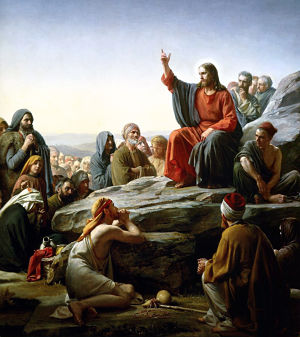
What about the rest of humankind?
The scope of resurrection stretches beyond today’s believing community; God’s promise embraces Adam’s whole family i.e. every human who dies. Jesus said: ALL (of humankind) that are [in the sleep of death] in the graves shall hear his voice and shall come forth (John 5:28-29).

The apostle speaks of “a resurrection of the just and of the unjust.” (Acts 24:15). The “just” (Christ’s faithful) shall rise in the “first resurrection” to reign with Christ from heaven over his kingdom on earth for a thousand years (Revelation 5:10; 20:4–6; 21:2 NIV).
The rest of humanity (the “unjust”) will also be raised to life on the earth, for a specific purpose. In John 5:29 this purpose is described by the Greek word krisis, often mistranslated as “damnation” in some older versions (e.g., KJV), but more accurately “judgment” (e.g., NASB), a term that allows for a verdict either for life or against it; in other words, they still have a real chance. [4] Raised to live under Christ’s just governance, these people enter a process of restoration, where they can be healed, taught, and tested in righteousness. “When your judgments come upon the earth, the people of the world learn righteousness.” (Isaiah 26:9 NIV). That’s right, biblical judgment includes a period of learning and rehabilitation! No wonder the kingdom of God is called the Times of Restitution of All Things.
Jesus and his risen followers, who are promised “authority over the [resurrected] nations” (Revelation 2:26) and who “will judge the world” (1 Corinthians 6:2), share in this work of setting things right, extending the water of life to the willing and repentant (Revelation 22:17) and guiding the risen human family into a healed way of living. Revelation 20 pictures this as a thousand-year reign, which 2 Peter 3:7–8 frames as a great “Day” of judgment, an appointed season in which God’s justice works itself out in a learning period across the world. During this rehabilitative period the Adversary is bound “so that he should deceive the nations no more” (Revelation 20:2–3), removing the lies and pressures that now push people away from truth, love and life.

There will be a Highway of holiness on earth (Isaiah 35:8). Humankind will learn righteousness and be judged by their response to Christ, subsequent progress and behavior (Isa 26:9, Matt 16:27, 25:31-46, Luke 12:48, Micah 4:1-3).
Note: Rev 20:5’s spurious first part is not in original manuscripts, hence bible translations mark the first clause in parentheses to signal manuscript issues (Eg. NIV). [5]
Not a “free pass,” but real testing and final justice
Restoration is mercy that tells the truth; it is not permissiveness.
What is the trial/testing? Scripture frames it as a public evaluation of participation in the King’s restorative work, pictured in the parable of the Sheep and the Goats (Matthew 25:31–46). People will be assessed by how they take part in the restitution: feeding the hungry, giving water to the thirsty, welcoming the stranger, clothing the poor, visiting the sick and those in prison, making peace, and caring for creation (cf. Isaiah 26:9; Matthew 16:27). Also, “at the end of the thousand years,” the Deceiver is to be “released for a brief period” to test people’s allegiance, whether they hold fast to what they learned during the thousand years and keep loving their neighbors as themselves even under hostile conditions (Revelation 20:3).
- Those who refuse Christ’s just and healing rule face “the second death,” a permanent end pictured by the “the lake of fire” metaphor (Revelation 21:8; 20:14 NIV). This stands in contrast to the “first death,” illustrated by the “sleep” metaphor (1 Kings 2:10; 11:43; Acts 7:60), because Jesus will wake you up from that one!
- Those who join Christ in the restorative work will share life on an earth where death, tears, and pain shall be no more (Isaiah 25:7–9; Revelation 21:4).
Why the delay?
If the horizon is restoration, the wait inevitably raises questions. Scripture responds with patience and formation. God allows the present age to unfold so that humanity experiences the consequences of injustice and so that a little flock can be shaped who faithfully follow the Lamb amid pressure and opposition (1 Peter 5:8; Matthew 7:14). This “elect” has always been “a few” from the beginning and throughout history, and the completion of their selection is a necessary precursor to the establishment of God’s government (Mark 4:11–12; Matthew 13:11–15). At the appointed time, “the kingdom of the world” will become “the kingdom of our Lord and of his Christ” (Revelation 11:15).
To sum up..
The Kingdom of God arrives on the Earth as a counter-imperial restoration: relationships are healed, creation is renewed, and justice/mercy are taught and practiced. Followers of Christ receive a special formation now for servant-leadership then; when the wider human family is to be raised from death, taught, and justly assessed under Christ’s rule, with deception restrained and death ultimately abolished.
- Scope: “For as in Adam all die, so in Christ all will be made alive.” (1 Corinthians 15:22)
- Mode: Restoration through teaching, shared tables, peacemaking, and care for the land (Leviticus 25; Luke 4:18–19; Romans 8:18–25).
- Followers of Jesus now: Apprenticed for non-dominating service and future stewardship (Revelation 3:21; 2 Timothy 2:12).
- Order of events: Resurrection and learning under Christ; testing and final justice; death removed (Romans 11:25; Revelation 11:15; Matthew 24:31; Revelation 21:4).
Questions for Further Study
- If God restores creation under Christ, how should we understand “hell” and “the lake of fire” in relation to “the second death”? (Revelation 20:14)
- Where do Jesus’ sayings about “weeping and gnashing of teeth” fit in this picture of the kingdom?
- How should we read the parable of the rich man and Lazarus?
- Some translations place the first clause of Revelation 20:5 in parentheses. What are they signaling, and how do textual notes guide responsible reading?
Read further – A Hell of a Question
References
- On Pax Romana as imperial “peace through domination,” see Encyclopaedia Britannica, “Pax Romana.” ↩
- On “restitution/restoration”: the Greek noun in Acts 3:21 is apokatastasis (ἀποκατάστασις), “restoration.” See BibleHub Lexicon, Acts 3:21 and Blue Letter Bible, G605. ↩
- On Ephesians 1:10 renderings (“to bring unity… under Christ”), see translation comparisons: BibleHub, Ephesians 1:10. ↩
- On krisis (κρίσις) in John 5:29 (“judgment/decision”), see BibleHub, G2920. ↩
- On the first clause of Revelation 20:5 and manuscript notes, see a brief overview with examples of bracketed/parenthetical renderings across major translations. ↩







Wonderful message…. The good news to all the mankind….
Paul says in Corinthians that the last enemy to be destroyed is death. That means all death, otherwise great article.Brian
Yes…. you are right Surya. The good news to all mankind.
Kindly continued the messages in fb.
Super kindly post in servant of god fellowship page too
wonderful. praise the Lord. ….amen
மிகவும் தெளிவான செய்தி. 1000வருட அரசாட்சியில் இரட்சிக்கப்படுவதை விட இப்போது இரட்சிக்கப்பட்டால் இரட்டிப்பு நன்மை.. ஆமென்.
Yes 100 percent u r right
Great article!
about the story of rich man and lazarus.does it not talk about life after we die.lazarus was enjoying while the rich man was suffering and he was requesting lazarus to assist him get out of trouble. can you explain that parable to those who advocate life after death.
The parable's appropriate explanation is available here, brother. Please check it out. https://www.christianityoriginal.com/mp/index.php…
ஆயிர வருட அரசாட்சியில் பூமியில் உயிர்த்தெழுப்பபடும் ஆண்களும் பெண்களும் திருமணம் செய்து குழந்தைகள் பெற்றுக்கொள்வார்களா?
Trying to be a member but cannot get in . Said to all admin HOW
It's wonderful to read the truth the whole truth and nothing but the truth.
The Kingdom of God a blessing to mankind but more importantly the glorification of our great God and our King Jesus Christ.
ஆயிர வருட அரசாட்சி எப்பொழுது ஆரம்பமாகும்.