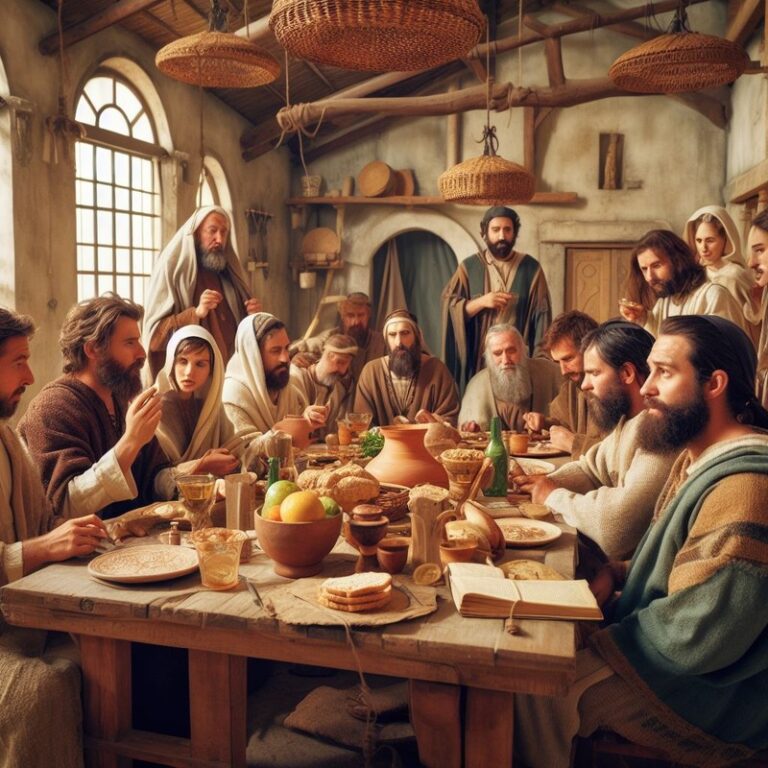

The story opens inside the Egyptian Empire under Pharaoh. It is not an equal society, but the text presents ordinary families as people who still have money, livestock, and land of their own. Into that world comes Joseph, a poor foreigner sold into slavery by his own brothers.
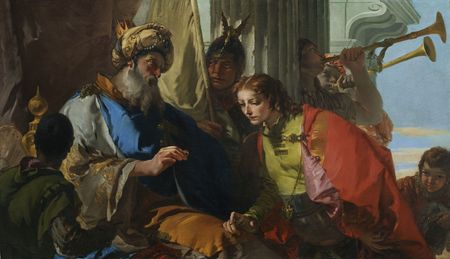
Joseph has a knack for interpreting dreams, and he uses that gift to survive and rise in the royal court, eventually interpreting dreams for Pharaoh himself. In the course of events, he reveals insider knowledge to the ruler about an impending famine in the land, and hence is asked to take charge of the Pharaoh’s government (Genesis 41:25-45).
Before the forecasted drought hits, he begins gathering and storing food on a massive scale.
‘Joseph was thirty years old when he entered the service of Pharaoh king of Egypt. And Joseph went out from the presence of Pharaoh, and went through all the land of Egypt. During the seven plenteous years the earth produced abundantly. He gathered up all the food of the seven years when there was plenty in the land of Egypt, and stored up food in the cities; he stored up in every city the food from the fields around it. So Joseph stored up grain in such abundance—like the sand of the sea—that he stopped measuring it; it was beyond measure.’
Genesis 41:46-49
Then the famine arrives.
‘Now there was no food in all the land, for the famine was very severe. The land of Egypt and the land of Canaan languished because of the famine’
Genesis 47:13
A Crisis That Reshapes a Society
Genesis 47 describes a crisis response that becomes something more than emergency relief. Step by step, the “solution” moves wealth and leverage away from families and toward the royal house, until the entire social order is re-written in Pharaoh’s favor.1
The pattern: money, livestock, land, then bodies
The text lays out the sequence with unusual clarity.
- First, money: the cash in the economy is transferred into Pharaoh’s house as people buy grain.
‘Joseph collected all the money to be found in the land of Egypt and in the land of Canaan, in exchange for the grain that they bought; and Joseph brought the money into Pharaoh’s house’ Genesis 47:14
- Next, livestock: once money is gone, families trade their animals for food, and Pharaoh becomes the owner of the herds.
‘When the money from the land of Egypt and from the land of Canaan was spent, all the Egyptians came to Joseph, and said, “Give us food! Why should we die before your eyes? For our money is gone.” And Joseph answered, “Give me your livestock, and I will give you food in exchange for your livestock, if your money is gone.” So they brought their livestock to Joseph; and Joseph gave them food in exchange for the horses, the flocks, the herds, and the donkeys. That year he supplied them with food in exchange for all their livestock.’ Genesis 47:15-17
- Then, land: the following year, with money and livestock already surrendered, the bargaining power is gone and the land transfers to Pharaoh.
‘When that year was ended, they came to him the following year, and said to him, “We cannot hide from my lord that our money is all spent; and the herds of cattle are my lord’s. There is nothing left in the sight of my lord but our bodies and our lands. Shall we die before your eyes, both we and our land? Buy us and our land in exchange for food. We with our land will become slaves to Pharaoh; just give us seed, so that we may live and not die, and that the land may not become desolate.” So Joseph bought all the land of Egypt for Pharaoh. All the Egyptians sold their fields, because the famine was severe upon them; and the land became Pharaoh’s. Genesis 47:18-20
- Finally, bodies: after money, animals, and land, the people themselves are reduced to servitude.
As for the people, he made slaves of them from one end of Egypt to the other. Genesis 47:21
Joseph then formalizes the arrangement with an enduring statute: people keep seed and work the land, but a fifth belongs to Pharaoh, making the new order stable and long-lasting.2
Now, it would be unfair not to highlight the obvious. Joseph’s preparation likely prevented mass starvation. Many readers praise the administrative competence on display. But the text also forces a harder question. Does crisis management have to become a permanent transfer of property and freedom from the many to the few? Or does Genesis quietly warn us how easily emergency rules can harden into a social structure that is difficult to reverse?3
The Irony
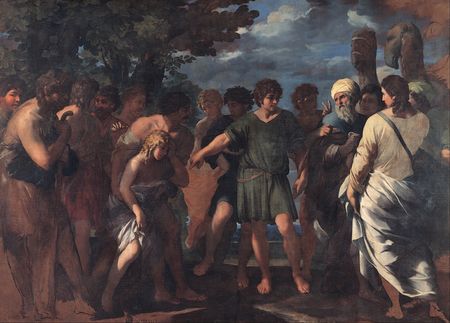
One detail is easy to miss if we only tell this story as Joseph leading all of it on his own. Joseph is not Pharaoh. The royal family holds the power. Joseph is a high-ranking administrator inside a machine that was already built for royal advantage, and he most likely had to operate within the boundaries that the court set for him.
There is also a bitter irony. Joseph himself had been brought to Egypt as a slave after being betrayed by his own brothers (Genesis 37:28). A former slave rises in the empire and becomes the agent through whom an entire population is reduced to servitude. The story is not inviting us to stereotype anyone. It is part of Israel’s own Scripture, and it should never be weaponized against any particular group of people. Rather, it exposes a recurring danger in human societies: people who survive oppressive systems can be pressured, trained, or incentivized to keep those systems running, even when the outcomes harm the vulnerable.
Once wealth and decision-making are concentrated at the top, history rarely shows those at the top voluntarily dismantling the arrangement. A ruler who possesses total control tends to want more of it, and tends to look for more bodies to place under it.
Years later, when a new Pharaoh takes charge, that is exactly what happens. The Israelites, the descendants of Joseph’s own family, are treated as a labor threat and then turned into forced labor for royal projects.
‘Now a new king arose over Egypt, who did not know Joseph. He said to his people, “Look, the Israelite people are more numerous and more powerful than we. Come, let us deal shrewdly with them, or they will increase and, in the event of war, join our enemies and fight against us and escape from the land.” Therefore, they set taskmasters over them to oppress them with forced labor. They built supply cities, Pithom and Rameses, for Pharaoh… The Egyptians became ruthless in imposing tasks on the Israelites, and made their lives bitter with hard service in mortar and brick and in every kind of field labor’
Exodus 1:8-14
Why This Still Matters
Genesis is not giving a modern economic textbook. It is giving a moral warning about what can happen when a crisis becomes the occasion for permanent leverage. In any age, when rules are rewritten during emergencies, the most important question is not only “Did people survive this year?” but also “Who gained the power to define the next ten years?”
That is why modern parallels can be mentioned carefully and with nuance. Large-scale crises can widen inequality for many reasons: policy choices, supply shocks, unequal access to capital, and the ability of the powerful to shape the terms of recovery. For example, during the first two years of the COVID-19 pandemic, Oxfam reported that the world’s ten richest men more than doubled their fortunes while incomes for many people fell. Whether one agrees with every framing or not, the data point still raises a sober question about safeguards when the world is under pressure.4
So what is the alternative? Is there a way for a community to survive drought, scarcity, and disruption without turning crisis into permanent domination? The Bible does not leave that question hanging. It places other stories right beside the Pharaoh-system, and those stories point toward a different kind of society.
Footnotes
- For scholarly discussion of Genesis 47:13–26 as a narrative that can be read as both crisis management and power consolidation, see K. Cha, “Joseph’s Unjust Economic Policies in Genesis 47:13–26,” Leaven (Pepperdine University), 2016 (PDF). Source. ↩
- For a careful, non-polemical discussion of Genesis 47:13–26 (including the 80/20 arrangement and the troubling permanence of “to this very day” in Genesis 47:26), see Rabbi Shai Held, “Saving and Enslaving: The Complexity of Joseph,” Center for Jewish Leadership and Ideas (Mechon Hadar), Parashat VaYigash (Tevet 5775), pp. 5–7. Source. ↩
- For mainstream commentary perspectives that highlight both the literary power of the Joseph story and its moral ambiguity, see Walter Brueggemann, Genesis (Interpretation) (1982), author information and links: Source, and Nahum M. Sarna, The JPS Torah Commentary: Genesis, book information (University of Nebraska Press page for the JPS edition): Source. ↩
- Oxfam press release (Jan 17, 2022) summarizing its findings on wealth gains among the richest and income declines during the first two years of the COVID-19 pandemic: Source. ↩
Read Next: The Anti-Imperial Yahweh