

Theme Text – “Jesus saith unto her, “Ye worship ye know not what: we know what we worship.” (John 4:21–22 KJV)
Worship that knows what it is doing
In John 4, Jesus speaks to a Samaritan woman who has inherited a worship-tradition, but also inherited a deep wound: competing holy places, competing authorities, and a history of being told where she can stand and who gets to decide what counts as “true.” Jesus does not treat worship as a vague feeling. He treats worship as a direction of life. And he names a danger that still haunts religious practice: “Ye worship ye know not what” (John 4:22 KJV).
That sentence is not an invitation to mock anyone. It is a summons to honesty. If worship is the highest act of devotion a human being can offer, then it matters who receives it and why we give it.
A familiar confession, and a real question
Across much of Western church history, churches have used a classic confession of Christian faith: the Athanasian Creed (also called the Quicumque Vult). 1 It famously uses the language of “Trinity” and calls this “Unity in Trinity” something that “is to be worshipped.”
“We worship one God in Trinity, and Trinity in Unity… the Father is Almighty; the Son Almighty; and the Holy Ghost Almighty… And yet they are not three Gods; but one God… the Unity in Trinity, and the Trinity in Unity, is to be worshipped.” 2
These words can feel dense, even when they are familiar. Creeds are often sincere attempts to summarize faith, but this series will begin one step earlier: with Jesus’ own words. Worship is not meant to be blind or merely inherited habit; it is meant to be rooted in understanding, shaped by Scripture.
Worship Under Empire
In the first-century world, worship was not only private devotion; it also functioned publicly, shaping loyalty, identity, and social order. In many cities across the Roman world, temples, festivals, and public honors trained people to speak about “worthiness,” “salvation,” and “lordship” in ways that could serve the empire’s story of power and peace. 5
One concrete example is what historians call the “imperial cult”: civic rituals that honored the emperor and Rome through temples, images, priesthoods, festivals, and offerings (often framed as acts done “for” the emperor’s welfare and the city’s stability). In that world, worship-language could become a loyalty-language. And Rome was not the first empire to sacralize power: older empires also blended throne and temple in their own ways: Babylonian royal ideology, Persian “king of kings” claims grounded in divine favor, and Greek/Hellenistic ruler cults that offered cultic honors to kings and queens. 6
John’s Gospel quietly places Jesus inside that world and refuses to let the empire have the last word. In fact, later in the same John 4 story, the Samaritan townspeople call Jesus “the Savior of the world” (John 4:42), a title that carried imperial associations. And they welcome him in a way that echoes how dignitaries were publicly received. 3 That does not turn the Gospel into propaganda; it sharpens the Gospel’s claim: if Jesus is “Savior of the world,” then worship and honor are being redirected away from imperial claims and toward the God whom Jesus reveals.
This is also why Revelation 4–5 matters so much in a world saturated with empire symbols. Revelation stages a throne-room where the language of “worthy” is not captured by any ruler, image, or system of domination; it is directed to God and to the Lamb. Read in its Roman setting, this worship becomes a kind of re-training: forming people whose devotion is not available for imperial use. 4
Who receives worship in the Biblical vision
1) God the Father
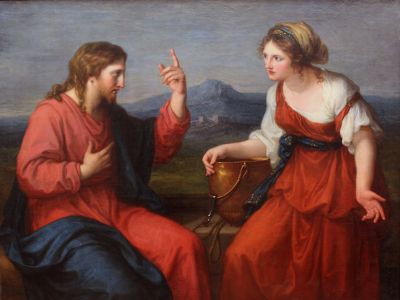
Jesus names the Father as the one to be worshipped:
“The true worshippers shall worship the Father” (John 4:21, 23).
In Revelation’s throne-room vision, worship is directed to the One “who sits on the throne”:
“Worthy are You, our Lord and our God, to receive glory and honor and power; for You created all things, and because of Your will they existed, and were created.” (Revelation 4:11 NASB)
2) Jesus Christ, the Son
The New Testament also presents Jesus as receiving worship and honor. God himself commands angels to worship the Son:
“And again, when God brings his firstborn into the world, he says, “Let all God’s angels worship him.” (Hebrews 1:6 NIV)
The Psalms frame the proper human response to God’s royal Son in worship-language:
“Pay homage to the Son or He will be angry and you will perish in your rebellion, for His anger may ignite at any moment. All those who take refuge in Him are happy.” (Psalm 2:12 HCSB)
In the Gospels, worship is offered to Jesus:
“And those who were in the boat worshiped Him, saying, “You are truly God’s Son!” (Matthew 14:33 NASB)
And Jesus explicitly ties honoring the Son to honoring the Father:
“so that all will honor the Son just as they honor the Father. The one who does not honor the Son does not honor the Father who sent Him.” (John 5:23 NASB)
So what are we learning?
At the simplest, scriptural level, worship is not scattered everywhere. It is disciplined and directed, even in a world where empires compete for honor and allegiance. The Bible consistently refuses worship of created beings, even when they are powerful or impressive (see Revelation 19:10 KJV). And when Scripture names who is “worthy,” it keeps returning to God and His Son (Revelation 4–5).
In the next post, we will slow down and ask a foundational question that sits underneath everything else: Who is “God Almighty” in the Bible?
Read Next: God Almighty – Who is it?
Footnotes
- A brief overview of the Athanasian Creed’s history and reception in Western Christianity can be found in Encyclopaedia Britannica, “Athanasian Creed.” ↩
- For one accessible full-text version of the creed, see “Athanasian Creed,” Christian Reformed Church in North America (CRCNA). ↩
- Craig R. Koester, “The Savior of the World (John 4:42),” Journal of Biblical Literature 109, no. 4 (Winter 1990): 665–680. ↩
- Warren Carter, John and Empire: Initial Explorations (London: T&T Clark, 2008). ↩
- Steven J. Friesen, Imperial Cults and the Apocalypse of John: Reading Revelation in the Ruins (Oxford: Oxford University Press, 2001). ↩
- For accessible overviews of Roman imperial cult as civic practice and its social meanings, see S. R. F. Price, Rituals and Power: The Roman Imperial Cult in Asia Minor (Cambridge: Cambridge University Press, 1984) and Ittai Gradel, Emperor Worship and Roman Religion (Oxford: Clarendon Press, 2004). For Hellenistic ruler cults (a key background for later imperial cult practices), see Angelos Chaniotis, “The Divinity of Hellenistic Rulers,” in A Companion to the Hellenistic World, ed. Andrew Erskine (Malden, MA: Blackwell, 2003). ↩



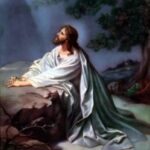


_-_James_Tissot.jpg)

Thanks for sharing with us. It's an interesting article. I just love it! Great work…
KLANJANJE – Bogu Jedinome Ocu JHVH
_____________________________________
SIN od Boga Jedinoga Oca JHVH –
G Yehoshua – SAM kaže KOME se klanja kao BOGU
i SAM svojim primjerom pokazuje KOME se treba Jedinome
klanjati KAO BOGU Jedinome
============================================
MATEJ 4,10
Tada mu reče Isus: "Odlazi, Sotono! Ta pisano je:
Gospodinu, BOGU SVOM SE KLANJAJ i njemu jedinom služi!
________________________________
MATEJ 26,39
I ode malo dalje, PADE NIČICE MOLEĆI: "OČE MOJ! Ako je moguće,
neka me mimoiđe ova čaša. Ali ne kako ja hoću, nego kako hoćeš ti.
_______________________________
LUKA 4,8
Isus mu odgovori: "Pisano je:
KLANJAJ SE GOSPODINU, BOGU svomu, i njemu jedinomu služi!
________________________________
IVAN 4,21
A Isus joj reče: "Vjeruj mi, ženo, dolazi čas kad se nećete
KLANJATI OCU ni na ovoj gori ni u Jeruzalemu.
—————————————————–
IVAN 4,23
Ali dolazi čas – sada je! – kad će se ISTINSKI KLANJATELJI KLANJATI OCU
u duhu i istini jer TAKVE UPRAVO KLANJATELJE TRAŽI OTAC.
___________________________________
IVAN 4,24
BOG JE DUH I KOJI SE NJEMU KLANJAJU,
U DUHU I ISTINI TREBA DA SE KLANJAJU.
————————————————————–
Agree with this article. this site recommended for read . renungan harian | renungan harian kristen | renungan harian katolik | renungan harian air hidup