
Theme Text
“Yet for us there is but one God, the Father, from whom all things came and for whom we live; and there is but one Lord, Jesus Christ, through whom all things came and through whom we live.” (1 Corinthians 8:6)
This series asked a simple question: when Christians say “God,” whom do we mean, and how did Jesus teach his followers to speak in worship? Along the way, we traced the Bible’s own pattern of speech about God Almighty, Jesus Christ, the Holy Spirit, and about how Scripture keeps worship clear, even when later centuries made the language more technical (including our walk through John 1:1 and the history behind later creedal formulas).
A simple confession in a world of many “lords”
Paul’s words in 1 Corinthians 8:6 are not written in a vacuum. In the first-century Roman world, public life was saturated with loyalty-language, and rulers were surrounded by titles that trained people to hear “lordship” as a political reality, not merely a private belief.1 Into that atmosphere, the apostolic confession sounds both reverent and steady: the Father is named as the one God, the source and goal of all things, and Jesus Christ is named as the one Lord, the one through whom God’s work comes to us.
That is why this confession matters for worship. It protects God’s singular identity, and it protects Jesus’ true glory, without handing either of them over to the habits of court-language. It also guards a daily posture: Believers do not “add Jesus” to a crowded altar of competing lords. They live “for” the Father, and they live “through” the Lord Jesus Christ (1 Corinthians 8:6).
When power starts setting the vocabulary
In the earliest generations, believers confessed Jesus as Lord while refusing the kinds of worship that belonged to the God of Israel alone. Over time, however, Christianity moved from being misunderstood and persecuted to being legally tolerated, and then increasingly supported within the empire’s public life.2 That change created a new pressure: leaders now had to defend the faith in official settings where unity, order, and public stability were urgent concerns, and where philosophical categories were the common tools of debate.
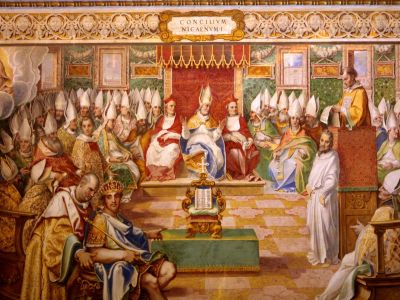
The councils of the fourth century did not arise because ordinary believers suddenly stopped loving God. They arose because disputes about Christ’s identity became empire-wide conflicts, and emperors themselves called gatherings in hopes of settling them.3 In that setting, the church’s vocabulary could begin to sound more like the language of halls, decrees, and definitions, and less like the language of Jesus teaching ordinary people how to pray.
This is not written as a verdict on anyone’s sincerity. Many faithful believers have inherited later formulas and have worshiped God with well-intentioned hearts. The purpose here is simpler: to ask whether Scripture itself gives a clearer starting place, and to choose that starting place for our worship.
Returning to Jesus’s prayer and Paul’s praise
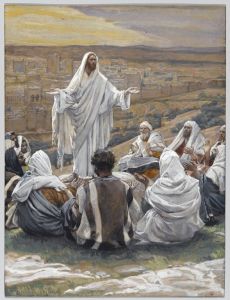
Jesus did not begin worship with a riddle. He began with an address: “Our Father in heaven, hallowed be your name,” (Matthew 6:9). He also reaffirmed ancient Israel’s confession of God’s singularity: “Hear, O Israel: The LORD our God, the LORD is one.” (Mark 12:29). In other words, Jesus taught his followers to honor the LORD (Yahweh), the God of the Scriptures, as Father, not as one rival “person” among others, and not as a distant force, but as the living God who is known, trusted, obeyed, and loved.
The apostles keep the same pattern. Paul prays to “the God of our Lord Jesus Christ, the glorious Father” (Ephesians 1:17), and he teaches the church to confess: “Jesus Christ is Lord, to the glory of God the Father.” (Philippians 2:11). This is worship that stays bright and speakable. The Father is not displaced, and Jesus is not diminished. Jesus is honored as Lord precisely in a way that returns glory to the Father.
When this pattern is recovered, worship becomes less tangled. Prayer has a direction. Praise has a center. The life of the church is protected from drifting into the kind of speech that impresses courts but confuses disciples. Paul’s warning becomes newly relevant: not “be corrupted from the simplicity that is in Christ” (2 Corinthians 11:3 KJV).
What this worship forms in us
When worship begins where Jesus begins, it quietly reforms loyalty. In a world that rewarded people for praising power, believers learned to praise the Father as the source of life, and to follow the Lord Jesus as the one who serves, suffers, and is exalted by God, not by violence. In a world that welcomed religion as long as it blessed the throne, Christians learned a different kind of public faith, one that refuses “other gods” (Exodus 20:3) and refuses to make peace with any rival lordship that demands the heart.
So the invitation at the end of this series is not to win arguments, but to regain clarity. Worship the Father as God Almighty, and Jesus Christ as the only-begotten Son and our Lord, and receive God’s Spirit as His holy gift at work in the lives of believers. And let worship shape allegiance, humility, and love, not confusion, fear, or spiritual one-upmanship.
Footnotes
- For an example of imperial “lordship” language functioning as a public loyalty-script, see Suetonius, Life of Domitian 13.2, where an official circular begins, “Our Master and our God bids that this be done.” ↩
- For primary witnesses to the early fourth-century shift toward legal toleration, see Lactantius, On the Deaths of the Persecutors 48, and Eusebius, Ecclesiastical History 10.5. ↩
- For Constantine’s involvement in convening Nicaea (325) and for the fourth-century conciliar settlement that culminates in Constantinople (381), see Eusebius, Life of Constantine 3.6–7; and for a standard scholarly treatment, Lewis Ayres, Nicaea and Its Legacy: An Approach to Fourth-Century Trinitarian Theology (Oxford: Oxford University Press, 2004). ↩





_-_James_Tissot.jpg)

1.thiimothy 3.16 just read pls
why does this matter if everyone is going to be saved?
idolatry is a filthy abomination that will cause people to be annihilated.