Theme Text
Savage wolves will come in among you. Even from your own number men will arise and distort the truth in order to draw away disciples after them. (Acts 20:29-30 NIV)
In the first-century world, titles were never neutral. Empires trained loyalty through public language: “lord,” “savior,” “son of god,” “divine.” In that environment, the Scriptures name Jesus as God’s Son in a way that comforts believers and quietly challenges imperial theater. Later, however, Christianity moved from being a persecuted minority to an imperially sponsored religion. That shift did not only change Christian public life. It also changed how Christian language was argued, enforced, and used.
This article continues the Scripture-first series on worship and identity. We studied about God Almighty and Jesus Christ, and explored questions on their relationship and origins. We learnt about the Holy Spirit, and dove deep into John 1:1 and the importance of understanding the True Son.
Now we step into history. Not to shame anyone’s faith, and not to turn the story into a simplistic battle of “good versus bad,” but to notice something Acts warns about: distortions can come from outside pressure, and also from inside the community when power, fear, and ambition reshape what discipleship looks like. The fourth and fifth centuries are a case study in what happens when the Roman Empire learns to speak Christian, and when the church learns to operate inside imperial peace.
Before councils, believers were already arguing under pressure
The earliest believers worshipped the God of Israel and confessed Jesus as the heavenly Christ and Son whom God raised and exalted. They did this inside a world that demanded visible loyalty to Caesar, often expressed through public ritual, civic festivals, and emperor-centered honor. When Christians refused, they were not simply “being religious.” They were declining the empire’s liturgy of belonging. That refusal could cost jobs, safety, and sometimes life.1
Under that kind of pressure, disputes about Jesus were not abstract. A community that is harassed will often reach for clearer boundary markers. It will ask: Who belongs? What must be confessed? Which teachers are safe? That is one reason the New Testament contains sharp warnings about “false teachers” and “spirits” and “antichrist,” and why some disputes became defining tests of identity.2
John’s letters and the denial that Jesus came “in the flesh”
By the late first century and into the second, some movements we loosely call “gnostic” spread teachings that treated the material world as defective and salvation as escape through secret knowledge. In that setting, one recurring claim was “docetic”: the idea that Christ only seemed to be human, only seemed to suffer, and therefore the cross was not truly what the apostolic witness said it was.3
This background helps a reader hear why the Johannine letters insist so strongly on the concrete, touchable reality of Jesus’ life and suffering. The point is not to inflate Jesus into an imperial-style deity. The point is to protect the gospel claim that God met humanity in a real human life by sending his Son, and that love is proved in a real cross, not in a myth that floats above bodies and history.4
At the same time, something understandable happened in communities that were trying to protect that apostolic witness. When a group denies Jesus’ real flesh, the church often responds by speaking more strongly about Jesus’ heavenly origin, his sending, his uniqueness, and his role in God’s saving work. The intent is pastoral and protective: it is meant to keep Jesus from being reduced to a mere inspirational teacher. Yet over time, strong protective language can be stretched into a total explanation, and what began as a defense of Jesus’ true humanity can drift into debates about how to map Father, Son, and Spirit with philosophical precision.4
The theological puzzle that kept growing: Father and Son
As believers defended Jesus’ true humanity against docetic denial, another set of questions grew louder: If they worship one God, how should they speak about the Father and the Son? Different teachers gave different answers. Some explanations leaned toward treating Father and Son as modes or masks of one actor. Others leaned toward language that sounded like two divine beings. Still others tried to preserve both God’s singularity and the Son’s true uniqueness by describing the Son as begotten and exalted, yet distinct from the Father’s own identity.
One well-known third-century position is associated with Sabellius, often described as “modalistic” teaching. Critics argued it blurred the distinction between Father and Son by describing them as temporary roles rather than as a real relational distinction.5
Importantly, none of these debates happened in a vacuum. They happened in a world where Rome valued religious stability, and where public unity was treated as a political good. When Christian disputes became visible and disruptive, emperors eventually had reasons to intervene, not only as believers, but as rulers.
The turning point: from persecution to imperial protection
In the early fourth century, the empire’s relationship to Christianity shifted dramatically. The Great Persecution (early 300s) did not erase the church. Then, within a decade, imperial policy moved toward toleration, restoration of property, and legal protection.6 A major marker in this transition is commonly associated with the “Edict of Milan” (313), tied to Constantine and Licinius, which represents a decisive move toward legal toleration and restitution for Christians.7
This new situation brought real benefits: public safety, the rebuilding of churches, and freedom to worship without hiding. It also brought new temptations. Once an emperor protects the church, the church can begin to imagine imperial power as a tool of the gospel. Once bishops can influence imperial policy, doctrinal disputes can become matters of state. And once doctrinal boundaries can be enforced by exile, confiscation, or legal penalty, theology can be turned into a mechanism of control.
Nicaea (325): a council inside imperial peace
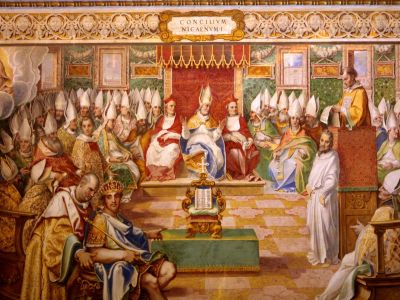
In 325, Constantine convened a council at Nicaea to address a controversy that had intensified in Alexandria and spread more widely, often associated with Arius, a presbyter whose way of speaking about the Son provoked fierce disagreement. One key reason the dispute escalated is that both sides believed the stakes were devotional and pastoral, not merely academic. How believers spoke about the Son would shape how Christians prayed, worshipped, and confessed one God in public.8
It also matters how Arius is framed. Arius was not trying to make Jesus “merely human.” He argued for Jesus’ heavenly origin and unique status, and aligned with the early belief system that emphasized the Father as the one unbegotten source, with the Son as begotten from the Father and therefore distinct. His opponents, however, feared that this way of speaking placed the Son too close to the category of “creature” and threatened the worship offered to Christ. It was a clash between rival attempts to guard what each side believed faithful worship required.
The Nicene Creed’s famous language includes the term homoousios (“of one substance” or “of the same being”) to describe the Son’s relation to the Father. That term is not a Bible verse. It is philosophical vocabulary used to settle an interpretation of the Bible. Some bishops were uneasy with the word, and at least two refused to sign and were exiled.9 One ancient witness preserves a letter in which Eusebius of Caesarea explains why he accepted the creed and how the key term was presented to him as a way of excluding the claim that the Son belongs to the class of created things.10
This is where the “tightrope” matters. Many bishops at Nicaea believed they were guarding Christian worship against a teaching they viewed as dangerous. At the same time, the council happened under an emperor who could reward compliance and punish resistance. Even when the theology was sincere, the enforcement belonged to empire. That combination made it easier for later rulers to treat doctrinal settlement as an instrument of imperial order.
After Nicaea: doctrine as a battlefield of alliances
Nicaea did not end the controversy. The decades that followed were marked by shifting coalitions, rival councils, contested bishops, and repeated exile and recall. That pattern is one sign that this was not a simple story of “truth instantly winning.” It was also a story of power, persuasion, patronage, and politics. When emperors changed, the church’s official direction often changed with them, and theological language could become a badge of loyalty to a regime as much as a confession of faith.11
For readers today, a lesson emerges: once Christianity lived inside imperial protection, it became easier for it to be used to protect empire. Not by making Caesar one of the “gods” of worship, but by turning Christian unity into a political project. A creed could become a purity test. A bishop could become an administrator. A spiritual disagreement could become a civic crisis.
Theodosius and the move from patronage to enforcement
By the end of the fourth century, imperial involvement moved beyond convening councils and toward defining what counted as “orthodox” Christianity for the empire. The Edict of Thessalonica (380), issued under Theodosius I (with Gratian and Valentinian II), is a turning point in that direction, associating imperial belonging with adherence to a Nicene form of faith.12
This is a crucial moment for understanding how Rome “took over” Christian public life. The empire did not simply adopt Christianity as a private devotion. It organized Christianity as a public identity that could be regulated. It reclassified Christian disagreements as threats to order. And it trained communities to think of coercion as a pathway to unity.
Constantinople (381): the creed expands and the Spirit is named more directly
In 381, the First Council of Constantinople reaffirmed Nicaea and produced the form of the creed that many churches still recite today. It speaks of the Holy Spirit as “the Lord, the giver of life,” and it also elevated the status of Constantinople in church honor because it was “New Rome.” That detail matters: it shows how closely ecclesial structure and imperial geography were now intertwined.13
Again, a balanced reading is needed. Many believers see this creed as an effort to safeguard worship and resist confusion. Yet the council’s authority was also carried by imperial power. The same machinery that protected the church could also discipline the church. The same “peace” that made public worship possible could also make dissent punishable.
Later summaries: the Athanasian Creed and “incomprehensible” language
A later Western confession often called the Athanasian Creed (the Quicumque vult) sets out a detailed formula of Trinitarian language and repeatedly insists that the doctrine is a mystery that cannot be fully comprehended. Most historians do not attribute this creed to Athanasius himself; it likely developed in the Latin West in the fifth or sixth century.14
For readers who are trying to think carefully, this is not a demand to mock anyone’s worship language. It is a reason to name what history shows: later centuries built technical frameworks to settle disputed interpretations, and once Rome could sponsor and punish, those frameworks could also function as political boundary markers.
What did Rome actually reshape?
If the goal is to understand how the Roman Empire reshaped Christianity to favor imperial stability, the reliable answer is not “Rome invented every Christian question.” Those questions were already being discussed as believers tried to be faithful to Scripture, resist false teaching, and confess Jesus truthfully in a hostile world.
But the empire’s decisive impact was this: it changed the conditions under which those questions were settled. Once Christian confession moved into imperial sponsorship, theological language could become a tool of public order. Debates that earlier churches handled through Scripture, prayer, and patient persuasion could now be “resolved” through imperial councils, imperial pressure, and, at times, imperial penalties.15
So this article is not asking readers to treat later creed formulas as the natural end-point of the New Testament. It is asking a different question: When Rome learned to speak Christian, what did Rome gain, and what did Christian communities lose?
- Discipleship could shift from marginal witness to public respectability.
- Confession could shift from worship language to state-defining language.
- Church leadership could shift toward imperial-style administration.
- Disagreement could shift from pastoral dispute to punishable disorder.15
That is why this history matters for every believer today, whatever language they use about God: the gospel does not need Caesar’s enforcement to be true, and the Kingdom of God is not built by coercion. When unity is produced by pressure rather than love, it may look peaceful, but it does not form the kind of community Jesus taught.
Acts 20 does not only warn about false ideas. It warns about leaders who “draw away disciples after them.” That can happen through deception, and it can happen through power. The Roman Empire’s greatest reshaping of Christianity was not merely in vocabulary. It was in formation: what kind of authority Christians learned to trust, and what kind of “unity” Christians learned to pursue.
Footnotes
- On Christianity’s contested place in Roman public life and the wider imperial context of loyalty, see Candida Moss, The Myth of Persecution: How Early Christians Invented a Story of Martyrdom (New York: HarperOne, 2013); and Peter Brown, Power and Persuasion in Late Antiquity: Towards a Christian Empire (Madison: University of Wisconsin Press, 1992). ↩
- On boundary-making and “false teacher” conflict in early Christian communities, see Judith M. Lieu, I, II, & III John: A Commentary (Louisville: Westminster John Knox, 2008), 1–20. ↩
- For a standard definition of Docetism and its basic claim, see Encyclopaedia Britannica, s.v. “Docetism,” accessed January 17, 2026. ↩
- On 1 John’s resistance to docetic-style denial and the pastoral stakes of confessing Jesus’ earthly life, see Encyclopaedia Britannica, s.v. “First Epistle of John,” accessed January 17, 2026; and Raymond E. Brown, The Epistles of John (New Haven: Yale University Press, 1982), esp. 47–70, 480–520. ↩ ↩
- On Sabellius and the “Sabellianism” label as a third-century controversy about Father–Son distinction, see Encyclopaedia Britannica, s.v. “Sabellianism,” accessed January 17, 2026. ↩
- For an overview of the Great Persecution as a late, intense phase rather than a constant condition, see Timothy D. Barnes, Constantine and Eusebius (Cambridge, MA: Harvard University Press, 1981), 12–40. ↩
- On the “Edict of Milan” (313) tradition and the move toward toleration and restitution, see “The Edict of Milan (313 CE),” Internet History Sourcebooks Project (Fordham University), accessed January 17, 2026, which draws on Lactantius and Eusebius as key ancient witnesses. ↩
- For a major scholarly account that reads Nicaea within fourth-century conflict and imperial involvement, see Lewis Ayres, Nicaea and Its Legacy: An Approach to Fourth-Century Trinitarian Theology (Oxford: Oxford University Press, 2004), 85–130; and Encyclopaedia Britannica, s.v. “First Council of Nicaea,” accessed January 17, 2026. ↩
- On the signing of the creed and the exile of the two bishops who refused, see The Cambridge Companion to the Council of Nicaea, ed. Young Richard Kim (Cambridge: Cambridge University Press, 2021), “The Aftermath.” ↩
- For Eusebius of Caesarea’s explanation of why he signed and how homoousios was framed, see Socrates Scholasticus, Church History 1.8, trans. A. C. Zenos, in Nicene and Post-Nicene Fathers, Second Series, vol. 2, ed. Philip Schaff and Henry Wace (Buffalo: Christian Literature Publishing Co., 1890); online text at New Advent, “Church History, Book I.” ↩
- For the long aftermath and the way doctrinal language became entangled with shifting imperial alliances, see R. P. C. Hanson, The Search for the Christian Doctrine of God: The Arian Controversy 318–381 (Edinburgh: T&T Clark, 1988), 1–50, 160–220; and Rowan Williams, Arius: Heresy and Tradition, 2nd ed. (Grand Rapids: Eerdmans, 2001). ↩
- For the Edict of Thessalonica (“Cunctos populos”) and its association of imperial belonging with Nicene faith, see “The Theodosian Code XVI.i.2 (380 CE),” Internet History Sourcebooks Project (Fordham University), accessed January 17, 2026. ↩
- On the Council of Constantinople (381), its creed language about the Spirit, and its canon linking ecclesial honor to “New Rome,” see Encyclopaedia Britannica, s.v. “First Council of Constantinople,” accessed January 17, 2026. ↩
- On the so-called Athanasian Creed, its later Western origin, and its non-Athanasian authorship in most historical accounts, see Encyclopaedia Britannica, s.v. “Athanasian Creed,” accessed January 17, 2026. ↩
- For a classic empire-and-church framing of how “Christian empire” reshaped authority, public identity, and coercion, see Peter Brown, Power and Persuasion in Late Antiquity: Towards a Christian Empire (Madison: University of Wisconsin Press, 1992), 7–32. ↩ ↩





_-_James_Tissot.jpg)

I am a former Seventh-day Adventist. I still keep the Sabbath and believe in many of the things they stood for early on. I am writing a book on the Trinity acceptance in said church which came in gradually. This information above is extremely helpful for this church claims they have found an "Adventist Trinity"….but it is not true. The Trinity they expouse has all the buzz words like "one substance" etc. Thank you for this info, it will help me greatly in writing my book and the gathering of evidence!
Just like Hydra infiltrating S.H.I.E.L.D. You think I kid, but I kid not.
I have read through your article and I was satisfied with the good information that you have contributed to your article! Thanks a lot for that beneficial article!
Kundalini Chakras
Share on Facebook
Share on Google+
Tekst iz linka kojeg prosljeđujem govori da su neki rani učitelji kršćanstva i povjesničari govorili o vjeri u Isusa kao Boga. http://www.svjedoci.net/index.php?fnc=Art&aid…
Agree with this article. this site recommended for read . renungan harian | renungan harian kristen | renungan harian katolik | renungan harian air hidup
Iam agree christin religion
Vidim po tekstu da ste od onih koji nijecu Isusovo bozanstvo…
Isus je Bog otisak njegove biti daleko smo od njegove biti prema tome drzimo se otiska jer to jedino imamo drugacije nemozemo Boga dokuciti badava se trudite ako pokusavate boga objasniti nijecuci Isusovo bozanstvo ili ako se netrudite za to onda ste u sluzbi promasenoga poz svima dobre volje
Very good information!. Thanks.