
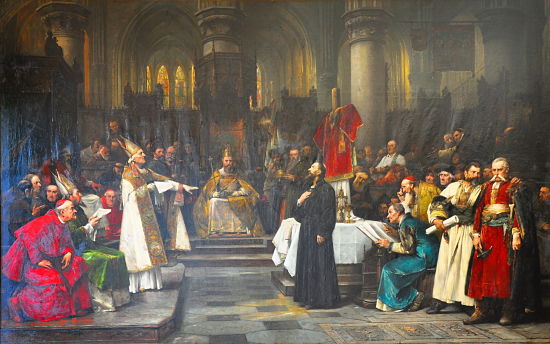
Theme Text: “No one is to deceive you in any way! For it will not come unless the apostasy comes first, and the man of lawlessness is revealed, the son of destruction, who opposes and exalts himself above every so-called god or object of worship, so that he takes his seat in the temple of God, displaying himself as being God.” (2 Thessalonians 2:3–4 NASB)
Early followers of Jesus were warned that, before the day of the Lord, there would be a falling away and a “man of lawlessness” who would exalt himself inside God’s “temple.” The New Testament letter known as 2 Thessalonians does not present this warning as a trivia puzzle. It is a pastoral alarm: sacred language can be captured by power, and communities can be pressured into giving ultimate loyalty to something other than Christ.
Many modern readers expect this “man of lawlessness” to be a single future individual. Others, including a long-running historicist Protestant tradition, have read the warning as a pattern that can unfold across centuries: political power and religious authority can fuse, and when they do, the result can “sit in the temple,” claiming a kind of final say over conscience, worship, and truth.
This article traces that historicist way of reading alongside the plain record of history, with a deliberate aim: not to attack any denomination or group of people, and not to deny the real good that faith communities have done in education, charity, and care, but to notice how the Roman imperial world’s habits of rule, law, and court religion could gradually remake the faith’s public form, sometimes pulling it away from the humble, servant-shaped kingdom Jesus proclaimed.
From Persecuted Communities to a Public Religion
In the first centuries, Jesus-followers were often socially vulnerable and at times persecuted. That changed when imperial policy shifted. The Edict of Milan (313 C.E.) legalized Christianity, and later emperors favored it with patronage, property, and prestige.[1] As the faith moved from house gatherings into basilicas, and from local elders into imperial courts, its public identity inevitably changed. This was not a simplistic story of corruption. It was also a story of protection, stability, and the possibility of organized charity on a scale earlier generations could scarcely imagine. Yet the change carried a cost: the state increasingly expected the church to function as a unifying civic force, and bishops increasingly had to navigate the logic of courts, laws, and imperial “order.”
The Council of Nicaea (325 C.E.) is a visible marker of this new reality. The council was convened under Constantine’s sponsorship, and its outcomes were tied to imperial enforcement in the decades that followed.[2] Later, the emperor Theodosius I’s Cunctos Populos decree (380 C.E.) associated imperial unity with Nicene confession and placed the weight of state authority behind “orthodoxy.”[3] In plain terms: the Christian faith was increasingly being woven into the fabric of Roman governance.
How Rome’s Bishop Gained Political Weight
Rome was the old imperial capital, and its bishop naturally carried symbolic weight. Over time, that symbolic weight could become administrative power, especially as the Western Roman empire fragmented and new rulers negotiated legitimacy. In the sixth century, Emperor Justinian I sought to restore imperial control in the West and also to stabilize church authority. In a famous 533 C.E. letter to Pope John II, Justinian spoke of the Roman See in language that elevated its standing among the churches.[4] At the same time, Justinian’s reconquest of Italy brought military force into the picture.
During the Gothic War (535–554 C.E.), Justinian’s general Belisarius entered Rome in 536 C.E., and later imperial forces secured Ravenna, the Ostrogothic capital, in 540 C.E.[5] Those events mattered because they show how church leadership in the West could be shaped by the realities of imperial restoration, military protection, and the political vacuum left by collapsing structures. In a historicist reading, this is the kind of long process that helps explain how a religious office could slowly come to resemble a throne, and why “sitting in the temple” could be heard as a warning about power claiming sacred space.
Is the “Man of Lawlessness” Connected to Revelation’s Sea Beast?
The New Testament does not explicitly say that the “man of lawlessness” is the beast from the sea in Revelation 13. Still, many readers see a strong family resemblance. Both images draw from the book of Daniel, where beasts represent empires and oppressive kingdoms, and where arrogant rulers “speak against the Most High” and “wear down” the holy ones (Daniel 7:25 NASB). In Revelation, the beast from the sea is widely read by historians and many scholars as a symbol of coercive political power, portrayed in monstrous form because it demands the kind of allegiance that belongs to God alone.[6]
In that sense, the analogy is clear: the sea beast represents political powers of the world, especially when they present themselves as ultimate, salvific, and unquestionable. The “man of lawlessness” likewise “exalts himself” and claims sacred space, “displaying himself as being God” (2 Thessalonians 2:4 NASB). The shared pattern is not simply personal evil. It is public power acting like a god.
Revelation strengthens the point by adding a second figure. Alongside the sea beast (political force), Revelation presents another beast associated with propaganda, signs, and persuasion, directing worship toward the first beast (Revelation 13:11–17). Many interpreters see in this pair a recurring structure in history: governments that demand allegiance, and religious or cultural systems that teach people to give it.[7] Read this way, the “man of lawlessness” functions as a warning that the community of God can be pressured into serving a worldly sovereignty, even while speaking God’s name.
When Faith Is Backed by Courts and Swords
One of the most sobering changes in church history is the move from persuasion to coercion. Jesus taught his disciples to love enemies, refuse retaliation, and bear witness with truth and patience (Matthew 5:39). Yet once the faith became intertwined with statecraft, “heresy” could be treated not only as spiritual error but as a civic threat. Medieval Europe developed multiple inquisitions over time, involving both church and state authorities. In the thirteenth century, the papacy organized inquisitorial structures more formally under Gregory IX, and later Pope Innocent IV’s 1252 bull Ad extirpanda approved the use of torture in certain circumstances within the wider heresy-prosecution system.[8]
A careful reading of history also requires care with numbers and headlines. Sources differ, local situations varied, and executions were often carried out by secular authorities after ecclesiastical verdicts.[9] Still, the basic moral contrast remains difficult to avoid: once faith is enforced by threat, imprisonment, and pain, something has shifted dramatically from the way of Jesus. This is precisely why many believers have returned, again and again, to apocalyptic warnings about power that “exalts itself” and presses into God’s space.
Worship, Devotion, and the Roman World’s “Religious Instincts”
As the faith became the public religion of cities and empires, it also absorbed and redirected the Roman world’s deep “religious instincts,” including the desire for visible holiness, sacred space, honored intercessors, and tangible contact with the divine. This helps explain why devotion to saints and relics expanded in late antiquity, often serving real pastoral needs for comfort and belonging.[10] Marian devotion, likewise, grew over time in complex ways that historians trace through worship, doctrine, and popular piety, especially in the centuries after the great christological debates of the fifth century.[11]
For many believers, these developments offered stability and consolation. The historicist concern is more focused: when a religious system becomes closely aligned with political power, devotional life can be used to train loyalty, and outward practices can begin to function as substitutes for the simple confidence of the gospel. In that situation, the warning about “lawlessness” is heard as a call to keep Christ as the living center, rather than allowing any institution, however venerable, to occupy the place that belongs to him alone.
Prophetic Time and the 1,260 Days
Many historicist interpreters connect Daniel’s “time, times, and half a time” (Daniel 7:25 NASB) with Revelation’s “forty-two months” (Revelation 13:5 NASB) and with the repeated “1,260 days” imagery (Revelation 12:6 NASB). From there, they apply a “day-year” reading, treating symbolic days as years, and then propose historical time spans that they believe match periods of intensified church–state dominance. This approach has a long history in certain Protestant traditions and has also been debated and critiqued in scholarly discussion.[12]
A careful posture is important here. Apocalyptic texts use layered symbols, cycles, and visionary scenes, and they can be flattened into rigid timelines if handled without humility. However one reads the time symbols, their purpose is not date-setting. Their purpose is formation: to train believers to resist oppressive power, endure suffering without surrendering conscience, and keep worship clear and undivided.
A Historical Turning Point: 1798 and the Loss of Temporal Rule
Historicist writers often highlight moments when the imperial papacy’s direct temporal power over territory and statecraft was sharply reduced. One such turning point came during the French Revolutionary era. In 1798, French forces occupied Rome and established a Roman Republic; Pope Pius VI was taken into captivity and died in 1799 while a prisoner in France.[13] Whatever one makes of prophetic schemes, the historical point is straightforward: the relationship between the papacy and political power changed dramatically in the modern period, especially as nation-states, revolutions, and new legal orders emerged.
Three Ways Believers Have Read These Warnings
Across church history, three broad approaches have often appeared:
- Historicist: the symbols describe recurring patterns through the centuries, especially the fusion of political force and religious authority.
- Futurist: the “lawless one” and related images point mainly to a final end-time crisis concentrated in a short period.
- Preterist: the symbols refer primarily to the first-century context of Rome and early Christian persecution.
In the late sixteenth and early seventeenth centuries, Jesuit scholars such as Francisco Ribera (futurist emphasis) and Luis de Alcázar (preterist emphasis) produced major works that shaped these conversations for later centuries.[14] The deeper lesson is not that one school “erases” history, but that each school can either sharpen or dull the Bible’s warning, depending on whether it helps communities resist worldly domination and keep their allegiance centered on Christ.
A Positive Test for Every Generation
The heart of the theme text is not suspicion. It is clarity. The “man of lawlessness” is a picture of power that craves sacred status. Revelation’s sea beast is a picture of political power that demands worshipful loyalty. When the church becomes a partner of such power, the faith can be remade into court religion, even while keeping biblical vocabulary. When the church refuses that partnership, it can remain what it was meant to be: a community shaped by the crucified and risen Christ, whose kingdom does not come through coercion and privilege, but through truth, mercy, and faithful endurance.
This is also why it is possible to honor the sincere faith of countless believers across history, and to be grateful for their works of mercy and learning, while still asking hard questions about any period, Catholic or Protestant, where Christianity was fused with the ambitions of rulers. The warning in 2 Thessalonians confronts every tradition: whenever an institution claims the kind of final authority that belongs to Christ, and whenever political force trains religious loyalty, the pattern of “lawlessness” is near.
Read Next: Daughters of Babylon
Footnotes
- “Edict of Milan,” Encyclopaedia Britannica, accessed January 22, 2026. https://www.britannica.com/topic/Edict-of-Milan. ↩︎
- “Council of Nicaea,” Encyclopaedia Britannica, accessed January 22, 2026. https://www.britannica.com/event/First-Council-of-Nicaea-325. ↩︎
- “Theodosius Code XVI.i.2 (Cunctos Populos),” Fordham University, Internet History Sourcebooks / Medieval Sourcebook, accessed January 22, 2026. https://sourcebooks.web.fordham.edu/source/codex-theod1.asp. ↩︎
- Justinian I, “Justinian to John, Most Holy Archbishop and Patriarch of the City of Rome,” in Codex Justinianus 1.1.8 (533 C.E.), in Fred H. Blume (trans.), Annotated Justinian Code (University of Wyoming Law Library), accessed January 22, 2026. https://www.uwyo.edu/lawlib/blume-justinian/ajc-edition-2/books/book1/Book%201-1rev.pdf. ↩︎
- “Belisarius,” Encyclopaedia Britannica, accessed January 22, 2026. https://www.britannica.com/biography/Belisarius. See also “Byzantine Empire: Justinian I,” Encyclopaedia Britannica (for the Italian campaigns and Ravenna), accessed January 22, 2026. https://www.britannica.com/place/Byzantine-Empire/Justinian-I. ↩︎
- For scholarly discussion of Revelation 13’s beasts in relation to Roman imperial power and emperor-cult pressures, see Steven J. Friesen, “Myth and Symbolic Resistance in Revelation 13,” Yale Summer Study (PDF), accessed January 22, 2026. https://summerstudy.yale.edu/sites/default/files/3._friesenmyth.pdf. ↩︎
- On the second beast (propaganda/persuasion) directing worship toward the first beast, see Craig R. Koester, “The Image of the Beast,” Luther Seminary Digital Commons, accessed January 22, 2026. https://digitalcommons.luthersem.edu/faculty_articles/248/. See also Friesen, “Myth and Symbolic Resistance in Revelation 13” (PDF). https://summerstudy.yale.edu/sites/default/files/3._friesenmyth.pdf. ↩︎
- “Inquisition,” Encyclopaedia Britannica, accessed January 22, 2026. https://www.britannica.com/topic/Inquisition. For the primary bull: Pope Innocent IV, Ad extirpanda (1252), English PDF at Documenta Catholica Omnia, accessed January 22, 2026. http://www.documentacatholicaomnia.eu/01p/1252-05-15,_SS_Innocentius_IV,Bulla%27Ad_Extirpanda%27,_EN.pdf. ↩︎
- “Inquisition (Summary),” Encyclopaedia Britannica, accessed January 22, 2026 (notes that executions were typically carried out by lay authorities after verdicts, and that the stated aim was often reconciliation). https://www.britannica.com/summary/Inquisition. ↩︎
- Peter Brown, The Cult of the Saints: Its Rise and Function in Latin Christianity (Chicago: University of Chicago Press, 1981), publisher overview accessed January 22, 2026. https://press.uchicago.edu/ucp/books/book/chicago/C/bo19109018.html. ↩︎
- Jaroslav Pelikan, Mary Through the Centuries: Her Place in the History of Culture (New Haven: Yale University Press, 1996), publisher overview accessed January 22, 2026. https://yalebooks.yale.edu/book/9780300076615/mary-through-the-centuries/. ↩︎
- For a scholarly survey of historicist “year-day” reasoning and its debates, see Elias Brasil de Souza, “The Year-Day Principle in Prophetic Interpretation,” Andrews University Seminary Studies 48, no. 2 (2010), and (for broader academic discussion/critique in reception history) David Leonard Bryden, “The Day-Year Principle of Prophetic Interpretation,” Stellenbosch University (thesis, PDF), accessed January 20, 2026. ↩︎
- “Pius VI,” Encyclopaedia Britannica, accessed January 22, 2026. https://www.britannica.com/biography/Pius-VI. See also “Roman Republic (historical territory, Italy, 1798–1799),” Encyclopaedia Britannica, accessed January 22, 2026. https://www.britannica.com/place/Roman-Republic-historical-territory-Italy-1798-1799. ↩︎
- Francisco Ribera, In Sacrum Beati Ioannis Apostoli & Evangelistae Apocalypsin Commentarij (1590), bibliographic trail (search) at WorldCat, accessed January 22, 2026. https://www.worldcat.org/search?q=In+Sacrum+Beati+Ioannis+Apostoli+Apocalypsin+Commentarij+Ribera+1590. For Luis de Alcázar’s Vestigatio arcani sensus in Apocalypsi (early modern edition), see Bayerische Staatsbibliothek / MDZ record, accessed January 22, 2026. https://www.digitale-sammlungen.de/en/details/bsb10326396. ↩︎





I came to this blog due to a meme on Facebook. I like what I read here, and it correspond with other authors that I have been reading, such as; Edward Irving, Juan-Josafat Ben-Ezra (Manual Lacunza), FW Schwartz, Isaac Newton etc. It is good to see this information from other sources.
This is a very accurate compilation of information that leads to the TRUTH but there is a single problem. The beginning is not there. The office of the Pope was established before, just before, the fulfilling of the promise of the coming of the Holy Ghost actually happened. Peter stood up to replace the one who betrayed the identity of Jesus as the Messiah to those who would eventually kill him. This is the moment in time the Catholic church came into existence. Peter took the position as head even before the coming of the Holy Ghost and not a single one in the upper room had the faith to say sit down and wait as Jesus said. If Paul had been there the book of Acts would have said …….on those days Peter stood up but Paul stood up too and ask what are you doing? Jesus said wait so sit down. Paul was not afraid of Peter and prooved it. The others no less than 3 times took the side of Peter against the word of the LORD. Paul not a single time did he bow to Peter or regard Peter. You the author seem to think the son of perdition is not "son" of perdition but "sons" of perdition and that is a HUGE mistake and you will NEVER see the TRUTH in context. You are correct in your post but you are wrong how you got there. Son of perdition refers to ONE. The bible is proof. Peter was so certain the son of perdition was 1 of the 12 he falsely accused Judas who was the betrayer of the LORD. There is ZERO doubt Judas was the betrayer. There is the word of the LORD Jesus saying he was. There are ZERO words of GOD that say Judas was the 1 of the 12 that was that son of perdition. Understand? ZERO words of GOD that call Judas the son of perdition and that is the problem. The word of GOD defends Judas and condemns The one who is the accuser of the brethren. The bible plainly rebukes Peters accusation as NOTHING. Peter was not inspired by the Holy Ghost to accuse anyone but was told to wait. Context ………… Jesus told Judas to "go quickly". Jesus told Peter, "wait" Who obeyed and who ignored the word of the LORD? Did you know that Judas was the second person to ID Jesus as the Messiah and expose him to those who would eventually kill him? When Judas ID Jesus it was time for him to be ID as the Messiah. He said it plainly and then told Judas to go. To the first he said woman, what have I to do with you, my time is NOT now. Unlike Judas who obeyed the word of the LORD the woman ignored Jesus word and told the men to do whatever he said. This was the first miracle Jesus did and this began his ministry that would end in his being killed. The woman's betrayal of the LORD as the messiah was the beginning of the ministry as the Messiah and the second betrayal of Jesus ID as the Messiah was the ending of his ministry before he was killed. If the woman is considered a devil then neither would Judas be a devil? Both would be called betrayer. Peter added to what the LORD said.
Im gonna stop here and hope someone sees and is curious to know more. There is a lot more.
At the end of the comment, I said ……….. If the woman is considered a devil then neither would Judas be a devil? Both would be called betrayer. Peter added to what the LORD said………………….. It should say ……. If the woman is NOT considered a devil then, Judas certainly was not a devil. Both would be called betrayer. Peter added to what the LORD said.
The perdition of son is correct (Rev 13:18 Here is wisdom: Let the one having reason count the number of the beast, for it is the number of a man and its number is six hundred and sixty six. Notice the scripture says he has the number of a man, Mans number is 6. God says his number is 666 : he is a man ,( He is not the Roman Catholic church ) he is not a system; he is a man He will rule in Jerusalem ,and not in Rome, ((2Thess 2:4.
who opposes and exalts himself against every so-called god or object of worship, so that he takes his seat in the temple of God, proclaiming himself to be God..
The man of lawlessness could be the pope he says he represents God on earth, therefore, he is God
The man of sin, a premier lawlessness is obviously Black Man.