
Theme Text: “I know that after my departure savage wolves will come in among you, not sparing the flock; and from among your own selves men will arise, speaking perverse things, to draw away the disciples after them.” Acts 20:29–30 NASB.
A follower of Jesus can listen to Scripture and history with care, speak clearly and kindly, and still invite honest reflection across belief traditions. The New Testament itself anticipates that communities can drift, not only through outside pressure, but also through inner disputes, competing teachers, and the slow reshaping of priorities. Acts preserves Paul’s warning to the elders at Ephesus that “savage wolves” can arise even “from among your own selves” (Acts 20:29–30 NASB). An early Christian letter likewise speaks of upheaval and deception, a great apostasy, as part of the community’s long journey (2 Thessalonians 2:3). These texts have been read in many ways, but they can function as caution lights for any age that assumes it is immune.
The Great Apostasy, is one way believers have described that long drift: a gradual movement away from the Bible’s own emphases as the Jesus movement spread across the Roman world, learned to speak in the categories of public institutions and philosophical schools, and eventually received official protection and sponsorship. This article explores that story as a historical possibility, while also honoring the sincerity of believers across traditions who have tried to follow Jesus faithfully within the teachings they inherited. The aim here is not to “win” an argument, but to encourage renewed attention to Scripture’s own horizon: resurrection, restored creation, and God’s Kingdom “on earth as it is in heaven.”[1]
The Great Apostasy as a Historical Question
When a community moves from the margins to the center of public life, it gains real opportunities and also faces new pressures. Unity can start to feel like a requirement of social stability, disagreement can be treated as a civic threat, and “right belief” can become a matter of policy rather than persuasion. In that setting, even sincere attempts to protect truth can end up reshaping the faith’s tone and priorities. That is why church history deserves patient study, not caricature.
From Persecuted Communities to Imperial Patronage
For the first three centuries, many Christian communities lived as minorities, sometimes tolerated, sometimes targeted, often without political protection. In the early fourth century, that situation changed quickly. After Constantine’s rise, imperial policy moved toward legal toleration, the return of confiscated property, and public recognition of Christian assemblies. What had been a movement shaped in households and local gatherings increasingly found itself negotiating with governors, emperors, and court officials.[2]
Once the church became publicly visible at scale, disagreements that had once been local could become empire-wide. Imperial leaders, seeking civic peace, sometimes treated theological conflict as a political emergency. This is one reason the fourth century is filled with councils: large meetings of bishops, often convened with imperial involvement, tasked with producing common language that could unify communities across vast regions.[3]
A short timeline (why the fourth century matters)
- 313: A policy of toleration and restitution is preserved in Lactantius (De Mortibus Persecutorum 48) and in Eusebius (Ecclesiastical History 10.5), reflecting the new legal standing given to Christians after decades of intermittent persecution.[4]
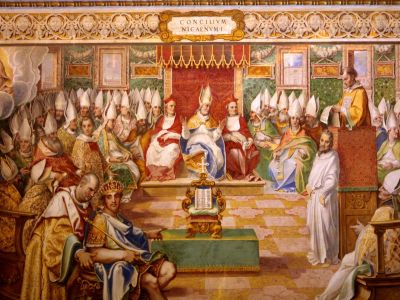
- 325: The Council of Nicaea is convened by Constantine to address the Arian controversy and to establish a creed intended for broad, empire-wide use, including the term homoousios (“of one substance”).[5]
- 380: Imperial law begins to define “orthodoxy” in state terms (commonly associated with the decree that opens “Cunctos populos”), creating consequences for dissenting groups.[6]
- 381: The Council of Constantinople reinforces Nicene commitments and confirms expanded teaching about the Holy Spirit in the creed that later becomes widely used in Nicene Christianity.[7]
None of this means that every doctrinal development was simply “politics in disguise.” Many bishops and theologians were trying to protect worship, preserve Scripture’s confession of Christ, and guard communities from confusion. Still, the setting matters. When belief is negotiated under the shadow of state power, language tends to harden, boundaries become legal categories, and “unity” can be pursued through coercion rather than persuasion. Many historians of late antiquity describe the result as a mixed legacy: real goods were gained, and real costs were paid, especially by groups that found themselves labeled, prosecuted, or excluded by law for holding minority positions.[8]
Death, Resurrection, and the “Immortal Soul”
The Bible’s center of gravity is resurrection. Again and again, the dead are pictured as awaiting God’s act of raising, not as living in an independent, naturally immortal state. That is why the New Testament can speak of the dead as “asleep” (for example, 1 Thessalonians 4:13–14), and why the prophets place hope in God restoring life, justice, and creation itself. Within that storyline, salvation is not escape from embodiment, but the healing of embodied life in God’s renewed world.
As the Jesus movement spread through Greek-speaking cities, believers also encountered long-standing philosophical traditions that asked different questions and assumed different answers. Some schools treated the soul as naturally immortal and imagined the highest good as release from the body. In time, some groups adopted and adapted parts of that vocabulary to explain faith to educated audiences, and those explanations could gradually reshape how ordinary believers imagined death, heaven, and the future. The result was not one uniform “replacement” of Scripture, but a slow blending: biblical resurrection language remained, yet it was sometimes heard through a cultural expectation that the soul’s destiny is the real story.[9]
A constructive way forward is not to mock later vocabulary, but to re-center the biblical emphasis. When Scripture is allowed to set the agenda, resurrection is not a side topic. It becomes the main horizon, and it reorients ethics, hope, justice, and the meaning of God’s “good news” for the world.
Judgment, Hell, and the Long Afterlife of Images
The Bible takes judgment seriously, and it also insists that God’s justice aims at the defeat of evil and the setting-right of what has been harmed. Across centuries, however, believers described the fate of the wicked in different ways, using different images and emphases. Part of the historical question is how certain images became dominant in people’s imagination, especially in periods when such teaching was tied to public order and moral discipline.
Scholars of late antiquity often describe a complex “traffic” of ideas: Jewish apocalyptic imagery, Greco-Roman moral philosophy, popular tales of the underworld, and the church’s own preaching and pastoral warnings. Over time, some streams emphasized endless conscious torment more heavily than others, and these emphases were reinforced through preaching, art, and later catechesis. The point here is not to flatten all traditions into one story, but to notice how cultural pressures and institutional needs can amplify particular images, sometimes beyond the Bible’s own patterns of speech.[10]
From Biblical Confession to Creedal Precision
The earliest Christians worshiped the one God of Israel, confessed Jesus as the heaven-sent Son and Lord, and spoke of God’s Spirit as God’s active presence and power. That core confession remains shared across many Christian traditions. The later creeds arose when believers, facing deep controversy, tried to articulate this confession with philosophical precision, often using technical terms not found in Scripture’s own wording.
In the fourth century, disputes about how to speak of the Son in relation to the Father became public and divisive. Constantine convened the Council of Nicaea in 325, hoping to secure unity, and the council adopted a creed that included the term homoousios (“of one substance”). Historians widely note that this language uses philosophical vocabulary to settle a theological dispute, and that the debate continued long after 325, leading to further councils and refinements. For many believers, the creeds functioned as guardrails for worship. For others, the same developments raised a concern: the church’s way of speaking about God had moved from narrative proclamation to metaphysical definition, and that shift happened in a setting shaped by public power and legal enforcement.[11]
It is possible to respect the pastoral intent of those councils, while also recognizing a difference between (a) Scripture’s own narrative and liturgical language and (b) later technical formulas developed under intense cultural and political pressure. Some believers find the creeds indispensable for safeguarding worship. Others prefer to speak as directly as possible in the Bible’s own terms. A charitable conversation begins when all sides admit the historical complexity, then return together to the Scriptures that formed the first communities in the first place.
Translation Choices and the Word “Hell”
English translations of the Bible did not drop out of the sky. Translators worked with inherited theology, inherited vocabulary, and inherited assumptions. Over time, this shaped what ordinary readers pictured when they encountered words about the grave and judgment. Several distinct biblical terms can be collapsed in popular speech into the single English word “hell,” even though the underlying Hebrew and Greek words do not all mean the same thing. In careful study, it helps to distinguish Sheol (the grave, the realm of the dead), Hades (often used as a Greek equivalent for Sheol in the Septuagint and New Testament contexts), and Gehenna (a place-name drawn from the Valley of Hinnom, used as a powerful image in Jesus’ warnings).[12] A wise posture is gratitude for translation work, combined with humility: returning to the underlying languages when a doctrine rises or falls on a single English word.[13]
The Kingdom of God and the Pressure of Power
Jesus teaches his followers to pray, “Your kingdom come, your will be done, on earth as it is in heaven” (Matthew 6:10). The prophets envision a world where justice is public, peace is real, the vulnerable are defended, and creation is renewed. In that biblical frame, the Kingdom of God is not merely a religious label for existing systems. It is God’s promised setting-right of the world, inaugurated in Jesus and completed at his return.
When the church gained imperial favor, it also faced a new temptation: to confuse visibility with fulfillment, institutional success with God’s reign, and political stability with the peace promised by the prophets. Augustine’s City of God is complex and cannot be reduced to a slogan, but it profoundly shaped how later believers imagined the relationship between the church, history, and society. In different eras, his work was sometimes received in ways that made the church appear as the Kingdom’s present form in the world, rather than as a pilgrim people awaiting the world’s renewal.[14]
A hopeful alternative is to let Kingdom language keep its biblical weight. That means continuing to practice mercy, justice, and neighbor-love now, while still refusing to collapse God’s future into any present institution, nation, or ruler. The church can be a sign and foretaste of what is coming, without claiming that God’s reign has been achieved by man’s empires.
Holding Convictions with Humility
Acts 20:29–30 does not invite fear, but vigilance. It reminds every generation that distortion can arise from within, especially when communities face pressure to secure themselves through status, control, or enforced uniformity. The fourth-century story shows how quickly Christianity could be reorganized once it moved from the margins to the center of public power. The most constructive response is not suspicion toward other believers, but renewed attentiveness: testing teachings in the light of Scripture, learning the church’s history honestly, and seeking the Kingdom that brings healing, justice, and restoration to the whole creation.
Read Next: The Man of Lawlessness
Footnotes
- For a widely used scholarly overview of the fourth-century shift and its consequences for doctrine, society, and church life, see Henry Chadwick, The Early Church: The Story of Emergent Christianity, rev. ed. (London: Penguin Books, 1993). ↩
- On Constantine’s policy shift and the complexities of the new legal standing of Christians, see Timothy D. Barnes, Constantine and Eusebius (Cambridge, MA: Harvard University Press, 1981). ↩
- On imperial involvement in ecclesiastical disputes and councils, especially the pursuit of unity as a political good, see H. A. Drake, Constantine and the Bishops: The Politics of Intolerance (Baltimore: Johns Hopkins University Press, 2000). ↩
- The toleration and restitution policy associated with 313 is preserved in Lactantius, De Mortibus Persecutorum 48, and in Eusebius, Ecclesiastical History 10.5. See also Barnes, Constantine and Eusebius, for historical discussion of these sources. ↩
- Lewis Ayres, Nicaea and Its Legacy: An Approach to Fourth-Century Trinitarian Theology (Oxford: Oxford University Press, 2004); Leo Donald Davis, The First Seven Ecumenical Councils (325–787): Their History and Theology (Collegeville, MN: Liturgical Press, 1983). ↩
- For the imperial decree commonly associated with Cunctos populos and its role in defining orthodoxy through law, see Codex Theodosianus 16.1.2 in Clyde Pharr, trans., The Theodosian Code and Novels, and the Sirmondian Constitutions: A Translation with Commentary, Glossary, and Bibliography (Princeton, NJ: Princeton University Press, 1952). ↩
- R. P. C. Hanson, The Search for the Christian Doctrine of God: The Arian Controversy 318–381 (Edinburgh: T&T Clark, 1988); Davis, The First Seven Ecumenical Councils. ↩
- On the benefits and costs of the church’s growing integration into public power and its use of coercion against dissent, see Drake, Constantine and the Bishops; and Chadwick, The Early Church. ↩
- On the contrast between resurrection-centered hope and traditions of soul immortality, see Everett Ferguson, Backgrounds of Early Christianity, 3rd ed. (Grand Rapids, MI: Eerdmans, 2003); Oscar Cullmann, Immortality of the Soul or Resurrection of the Dead? The Witness of the New Testament (London: Epworth Press, 1958); and N. T. Wright, The Resurrection of the Son of God (Minneapolis: Fortress Press, 2003). ↩
- For historical development of “hell” imagery across Jewish, Greco-Roman, and early Christian worlds, see Alan E. Bernstein, The Formation of Hell: Death and Retribution in the Ancient and Early Christian Worlds (Ithaca, NY: Cornell University Press, 1993). ↩
- Ayres, Nicaea and Its Legacy; Hanson, The Search for the Christian Doctrine of God; and Davis, The First Seven Ecumenical Councils. For the political dimension of “unity” and enforcement, see Drake, Constantine and the Bishops. ↩
- For careful distinctions among Sheol, Hades, and Gehenna, see The Anchor Yale Bible Dictionary, ed. David Noel Freedman, 6 vols. (New York: Doubleday, 1992), relevant entries; and Walter Bauer, Frederick W. Danker, William F. Arndt, and F. Wilbur Gingrich, A Greek-English Lexicon of the New Testament and Other Early Christian Literature, 3rd ed. (Chicago: University of Chicago Press, 2000), relevant entries. ↩
- David Norton, A Textual History of the King James Bible (Cambridge: Cambridge University Press, 2005). ↩
- Augustine, The City of God. For influential analysis of Augustine’s theology of history and its reception, see R. A. Markus, Saeculum: History and Society in the Theology of St. Augustine (Cambridge: Cambridge University Press, 1970). ↩





Greetings and peace:
I hope my response may help in your search for truth. Jesus did not cry Eloi, Eloi, lama sabachthani out of despair nor was it addressed to his Father. Jesus was quoting Psalm 22:1 and it was for the benefit of the Jews there at Golgotha. He was declaring to them that the Messianic Prophecy was being fulfilled right before them. Right after that he declared."it is finished" the last phrase, when properly translated, of Psalm 22. Remember, he came for the Jew first, and those declarations he uttered from the cross would be the last plea to the Jews to see him as their promised Messiah.
I think maybe we all should read the word of God a little more carefully. I wish you well my friend, and God Bless.
JP
A good article to read is called Pagan Origins of the Catholic Church on the hope of Israel site. The author Dr Ernest L Martin goes over how Simon Magus introduced Babylonianism into the Church of Rome.