
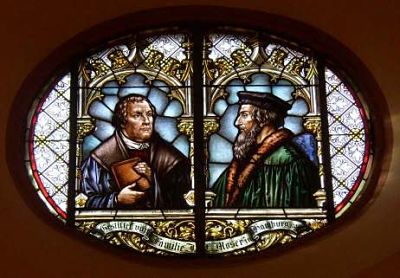
Theme Text – “The woman was adorned with gold.. having in her hand a gold cup full of abominations.. and on her forehead a name was written, a mystery, ‘BABYLON THE GREAT, THE MOTHER OF HARLOTS AND OF THE ABOMINATIONS OF THE EARTH.’ (Revelation 17:4–6 NASB)
Reformation: a sincere return to Scripture, inside a political world
When people hear “Reformation,” they often picture courage, Bible-reading, and a return to the words of Jesus. That picture is not wrong. Luther, Calvin, and many others did real spiritual work: they called ordinary believers back to Scripture, challenged abuses, preached faith and repentance, and helped renew public attention to the gospel.1
At the same time, the Reformation unfolded in a world where religion and government were already tightly interwoven. Princes, city councils, emperors, and courts did not simply “watch” the church. They protected it, regulated it, taxed it, and often used it to stabilize public life. That entanglement helps explain why the Reformation produced genuine reform in some areas, while also reproducing some older patterns of power in new forms.2
What the Leaders saw clearly, and what they could not fully escape
Many Reformers identified serious problems in late-medieval Christianity: the sale of indulgences, the concentration of spiritual authority, and a growing distance between church leadership and the ordinary people of God. Some Reformers even read biblical warnings (including “man of lawlessness” language) as a critique of the papal system as it functioned in their day.1
But reform does not happen in a vacuum. In much of Europe, reforming the church also meant negotiating with rulers who wanted unity, stability, and loyalty within their territories. That is one reason why, even after major theological disputes erupted, European settlements often treated religion as something a ruler could administer for a whole population.3
Why it quickly became a state matter
A turning point was the Peace of Augsburg (1555), which established a framework for public order in the Holy Roman Empire by tying a territory’s official religion to its ruler. This did not create modern religious freedom for individuals. It tried to reduce conflict by giving political authorities the power to decide what would be publicly practiced in their lands, and it pressured dissidents to conform or relocate.3
This pattern shaped both Catholic and Protestant worlds. Once a church becomes a public instrument of the state, it is constantly tempted to seek security through alliances, privileges, and coercive power, even when sincere believers inside it want something better. Over time, the question can subtly shift from “How do we follow Christ?” to “How do we hold the territory?”4
The tragic cost: “holy” conflict and ordinary people caught in the middle
Europe’s wars of religion were not only about doctrine. They were also about dynasties, borders, economics, and rival alliances. Still, religious identity became a rallying banner, and many people learned to see violence as devotion. The St. Bartholomew’s Day massacre (1572) and the long series of French Wars of Religion show how quickly fear and factional loyalty can eclipse neighbor-love.5
The Thirty Years’ War (1618–1648) is another sobering example. It began within a fractured religious landscape but expanded into a complex multinational conflict, leaving enormous human suffering in its wake.6 The Peace of Westphalia (1648) ended major phases of that conflict, but the scars remained, and “Christendom” increasingly looked like competing political projects with religious labels.7
Revelation’s warning as a pattern: when faith is captured by kings
Revelation 17–18 uses vivid imagery to warn against a religious city that gains splendor through intimacy with political power, and then becomes intoxicated with dominance. Whatever one’s precise identification of “Babylon,” the moral pattern is clear: a community meant to belong to God can be seduced by rulers, wealth, and public prestige. This is why Revelation portrays the woman as “adorned,” holding a “gold cup,” and yet full of “abominations.”
Revelation also speaks of “seven hills” (Revelation 17:9), language that many readers connect with Rome, famously associated with seven hills in ancient and later descriptions.8 The point, though, reaches beyond one city: wherever faith is treated as a tool of statecraft, it is pressured to imitate the habits of power.
“A reputation of being alive”
Jesus warns a church that looked impressive from the outside but was spiritually hollow inside:
“I know your deeds; you have a reputation of being alive, but you are dead.” (Revelation 3:1)
This kind of warning can apply to any era, including periods of reform. A movement can look alive because it is loud, organized, and influential, while still being shaped by fear, rivalry, and the hunger for control. That is why Scripture repeatedly brings God’s people back to a different standard: not mere institutional strength, but the life of the Kingdom, expressed in truth, humility, mercy, and steadfast love.
Daniel’s prophecy also carries a quiet realism about mixed motives in public religious movements:
“When they fall, they will receive a little help, and many who are not sincere will join them.” (Daniel 11:34)
The Reformation did bring “a little help” in real ways: Scripture came closer to ordinary people, and many sincere believers sought renewal. Yet political loyalties also rushed in. In the long run, that mixture helps explain why new institutions sometimes repeated old errors, especially when rulers treated the church as a pillar of national strength.2
What about today?
The better question to ask is not “Which institution deserves automatic trust?” but “Which communities are learning the habits of God’s Kingdom?” Political power can grip faith in every century, whether through state privilege, social status, or the pursuit of prosperity and influence. The Bible’s call is not to cynicism, but to discernment and hope: to follow Christ, to love neighbors, and to refuse the logic that treats people as disposable for the sake of victory.
That is also why we keep returning to foundational questions that history alone cannot answer: What is the gospel of the Kingdom? What teachings entered later through tradition and politics?
In other words, Scripture does not ask for blind loyalty to “religion allied with rulers.” It calls believers to pray and live toward God’s future:
“Your kingdom come, your will be done, on earth as it is in heaven.” (Matthew 6:10 )
Footnotes
- Diarmaid MacCulloch, The Reformation: A History (New York: Viking, 2004). ↩ ↩
- Euan Cameron, The European Reformation, 2nd ed. (Oxford: Oxford University Press, 2012). ↩ ↩
- “The Religious Peace of Augsburg (September 25, 1555),” German History in Documents and Images (GHI), English translation PDF: GHI Document 67 (PDF). ↩ ↩
- Council of Trent, Encyclopaedia Britannica: Britannica article. ↩
- Massacre of St. Bartholomew’s Day, Encyclopaedia Britannica: Britannica article. ↩
- Thirty Years’ War, Encyclopaedia Britannica: Britannica article. ↩
- Peace of Westphalia, Encyclopaedia Britannica: Britannica article. ↩
- Seven Hills of Rome, Encyclopaedia Britannica: Britannica article. ↩





Truly so beautiful review so amazing and I really impressed by reading your review because it is what I want to read and stay blessed
The early Church in Acts 1 came out of Christ.Only that which comes out of Christ can we trust seem the Church.When a person is born of the Spurit it joins Himself to that person's human spirit.Individually he is a member of the Body of Christ;corporately with others they.are the habitation of God in Spirit.As each member abides in Christ they grow into the dwelling place of God.This is not an organization or building ,but living organic dwelling that initiated by Christ,sustained by Christ,and completed by Christ.This is why Jesus said that He alone would build His Church.Everything else that doesn't issue from Him is part Of Babylon the Great Harlot and her daughters.
Amen
This understanding has been coming to me a little bit at a time over a number of years. The Gentile "church", playing church and having worldly prosperity and power, is nothing to me anymore. Although I was raised in the Presbyterian expression of the "faith once delivered", and after I left that I was in Pentecostal or Evangelical movements, I left them all, because they falsely "worship" Gentile "Jesus", who abolished YHVH's divine, eternal Law/Torah, and uphold sin. (transgression of the Law/Torah from 1 John 3:4). The "Lion of the Tribe of Yehudah,", Messiah Yeshua, upholds the Law/Torah and abolished sin! HalleluYAH!!! Thank you, Bill, for your reply of 48 weeks ago! The Body of Messiah is a supernatural thing…from the light side of the supernatural, NOT the dark side! So much more to say, but gotta leave it at that, for now. Baruch B'Shem Yeshua