







Category A Hell of a Question

The Real ‘Hells’

Four words have been translated as hell in the Bible – Sheol, Hades, Gehenna and Tartaroo. The first one is Hebrew (Old Testament) and the rest are Greek (New Testament). Do all of these words mean the same? (At least that's what many of the English bible translations imply). Or do they mean different things?
When we refer to Hebrew and Greek dictionaries and the Bible's own descriptions of these words, we find deeper insight into their meanings.
And we also get clarity on many seemingly contradictory verses in the English bibles.

A Hell of a Story

Won’t it be alright to use hell fire (even if it’s false) as a threat to frighten people into submitting to God? Not really. A disappointed God says, ‘Their fear toward me is taught by the precepts of men’ (Isa 29:13). He rather desires a willingly obedient heart driven by love for Him and goodness - not by fear. And the idea of torment is abhorrent to God. God forbade torture in His Law. Would a God who commands us to love our enemies, wish to burn them forever?

Fate of Adam & the Bad Guys

Where are the dead at present? Is there any hope for them? There is a hell – SHEOL/HADES to which ALL our souls were condemned when Adam fell. That hell is the GRAVE. But there is hope! God promised to RANSOM us from the power of the grave [SHEOL] (Hosea 13:14). He sent Jesus (John 3:16) to die in place of Adam. Jesus paid Adam’s RANSOM and paved the way for the resurrection of all of Adam (Rom 5:12,18). Jesus is the RANSOM for ALL (1Tim 2:6). As in Adam ALL die, so in Christ ALL will be made alive (1Cor 15:22).

A History of What the Hell!

Pagan ideas of a fiery netherworld date back as far as Egypt's Nimrod. Way before Christ, in the 6th century BC, Zoroaster taught the Persians of a Lord of Lies who lived in the dark reaches under the earth recording the deeds of men as debits and credits. After death, souls went to be judged, and if found evil, would be doomed to torment. To easily win pagan converts, the church adopted these theories and began relating Zoroastic meanings to symbolic verses. Apostle Paul predicted such distortions (apostasy) would occur (Acts 20:29-30).

A Parable for the Ages

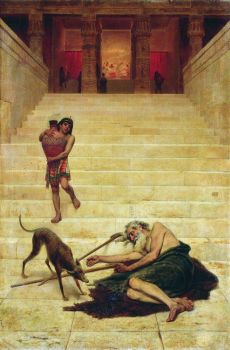
Some take the Parable of the Rich Man and Lazarus literally to preach torment. But if taken literally, the parable seems to imply absurdities -- Lazarus is blessed not because of faith, but just because he was sick and poor. So will only the poor/sick will be saved? And if this hell is literal, mustn’t Abraham's bosom also be a real place where millions of poor will reside? Jesus told this story as a symbolic lesson to the Pharisees. What really was his message?

Weeping & Gnashing of Teeth

Didn’t Jesus talk about a place where there would be weeping and gnashing of teeth? This expression is found in seven places - Matthew 8:12; 13:42, 50; 22:13; 24:51; 25:30, Luke 13:28. This is heavily symbolic as Jesus uses it only in a parable or a symbolic statement all seven times. Its meaning differs based on the context. But its general sense in all the places is – a finite period of punishment/trial for a group of people who have erred in God’s sight.

Tartaroo – Bad Angel Lockdown

The Greek word tartaroo occurs only once in the Bible and has been translated as hell. "God spared not the angels that sinned, but cast [them] down to hell, and delivered them into chains of darkness, to be reserved unto judgment." (2 Peter 2:4). – Here, the entire phrase ‘cast down to hell’ is translated from the one Greek word tartaroo. Some misuse this verse to support a netherworld where fallen angels and sinners are held forever. But there are obvious problems with that view.

Gehenna – Eternal Lake of Fire

The Greek word Gehenna is translated as hell 12 times. If Gehenna denotes hell, we can actually book a flight and go to hell! Yes, it’s a real place in Israel. That’s why translations like YLT render it as Gehenna instead of hell. When Jesus says ‘the fire in Gehenna’, it’s like a New Yorker saying ‘the water in Brooklyn’! The Valley of Hinnom, named Gehenna in Greek, lies just outside the city of Jerusalem. During Jesus’ time, it was the city’s garbage burner. Its fires were kept continually burning (everlasting fire).

Sheol/Hades – Translators Gone Rogue

Translators of the King James Bible rendered the Hebrew word SHEOL (65 occurrences) in English as grave (31 times), pit (3 times) and hell (31 times). They translated SHEOL as grave/pit when it was to be the resting place for good people, but rendered the same word as hell when referring to a bad person. Job actually prays to go to SHEOL (Job 14:12). And any Hebrew expert or even Wikipedia would confirm that SHEOL means grave/pit. The Bible actually describes what kind of a place SHEOL is!

‘Burn in Hell’ Theory

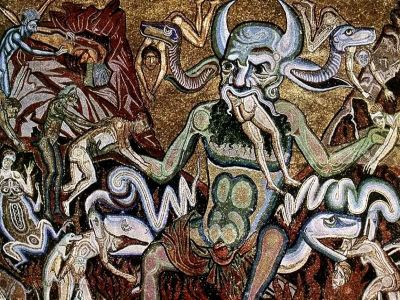
Preachers warn from their pulpits – ‘If you don’t accept Christ as your Savior, you are condemned for your sins! When you die, you would be sent alive to hell to be tortured forever in raging fire!’ Eternal torment is the ominous warning. Many claim that a fire-proof Satan rules this underworld and that his demons torture the people cast down there. On what basis is this preached? What is the soul’s punishment for sin according to the Bible? Does the Bible preach eternal torment?

Scriptures, unless otherwise indicated, are taken from THE HOLY BIBLE, NEW INTERNATIONAL VERSION®, NIV® Copyright © 1973, 1978, 1984, 2011 by Biblica, Inc.® Used by permission. All rights reserved worldwide. Scriptures indicated NASB are taken from the NEW AMERICAN STANDARD BIBLE®, Copyright © 1960,1962,1963,1968,1971,1972,1973,1975,1977,1995 by The Lockman Foundation. Used by permission. Scripture quotations marked (NLT) are taken from the Holy Bible, New Living Translation, copyright © 1996, 2004, 2007 by Tyndale House Foundation. Used by permission of Tyndale House Publishers, Inc., Carol Stream, Illinois 60188. All rights reserved. Scripture quotations marked HCSB are taken from the Holman Christian Standard Bible®, Copyright © 1999, 2000, 2002, 2003, 2009 by Holman Bible Publishers. Used by permission. Holman Christian Standard Bible®, Holman CSB®, and HCSB® are federally registered trademarks of Holman Bible Publishers. Wherever indicated NCV, scripture taken from the New Century Version®. Copyright © 2005 by Thomas Nelson, Inc. Used by permission. All rights reserved.

Image Credits - Hell Frozen Over: Christian-Graphics.net; Gehenna Valley: Photo by wkeown, available under a Creative Commons Attribution-Generic license; Quill & Glasses: Simon Howden / FreeDigitalPhotos.net; Figure chained to a ball: David Castillo Dominici / FreeDigitalPhotos.net; Pharisees: Image from Duccio [Public domain], via Wikimedia Commons; Lazarus at Rich Man's Gate: Image from Fyodor Andreyevich Bronnikov [Public domain], via Wikimedia Commons; Demon in Hell: Image by Coppo di Marcovaldo [Public domain or Public domain], via Wikimedia Commons; Child Sacrifice: Image by Charles Foster [Public domain], via Wikimedia Commons; What about me? - Photo by Hunter McGee in creationswap.com; Hell on keyboard: t0zz / FreeDigitalPhotos.net