In 2024, approximately 673 million people around the world faced hunger, a number that has barely budged from pandemic-era highs.1 At the same time, the world wasted over one billion tonnes of food in a single year, enough to fill more than one billion meals every day, much of it discarded in households, restaurants, and retail chains.2 Hunger and waste exist side by side, not because the earth cannot produce enough, but because food is gathered, stored, and distributed according to the logic of accumulation rather than the logic of shared need.
That tension is not new. It runs through one of the oldest stories in Scripture: the story of a recently liberated people, wandering through a wilderness with nothing to eat, and a God who feeds them with a strange provision that comes with very specific rules. The rules are simple. The consequences for breaking them are immediate. And together they form what might be called the Manna Principle: the first economic lesson Yahweh teaches a community freshly extracted from an empire built on hoarding.
Hunger in the Wilderness
The previous post traced how Yahweh liberated the Israelites from Egypt and began forming an alternative society in the wilderness, outside the reach of empire. But freedom, in its earliest days, felt more like deprivation than deliverance. The people were hungry. And hunger has a way of making captivity look appealing in hindsight.
The whole congregation of the Israelites complained against Moses and Aaron in the wilderness. The Israelites said to them, “If only we had died by the hand of the LORD in the land of Egypt, when we sat by the fleshpots and ate our fill of bread; for you have brought us out into this wilderness to kill this whole assembly with hunger.”
Exodus 16:2-3
The complaint is understandable. In Egypt, even slaves ate. The empire extracted everything it could from the people, but it also kept them alive as a labor force. That is part of the cruelty of imperial systems: they provide just enough sustenance to make slavery feel survivable and freedom feel reckless. The people’s nostalgia is not a moral failing. It is the aftershock of generations spent under a system that tied survival to submission.3
Yahweh hears the complaint and responds. But his response is not simply a gift of food. It is a test.
Then the LORD said to Moses, “I am going to rain bread from heaven for you, and each day the people shall go out and gather enough for that day. In that way I will test them, whether they will follow my instruction or not.
Exodus 16:4
The Hebrew word behind “test” here is nasah (נָסָה), a word that carries the sense of proving or refining, not punishment.4 Yahweh is not trapping the people. He is training them. After generations of living under the Egyptian model, where food was centralized under Pharaoh and distributed as a tool of control (Genesis 47:13-21), the people need to learn a completely different way of relating to provision.
What Is It?
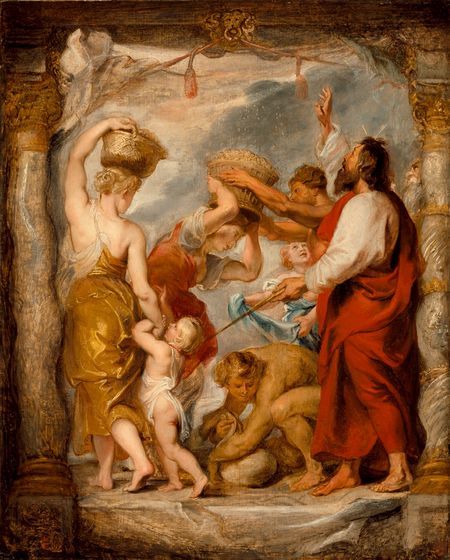
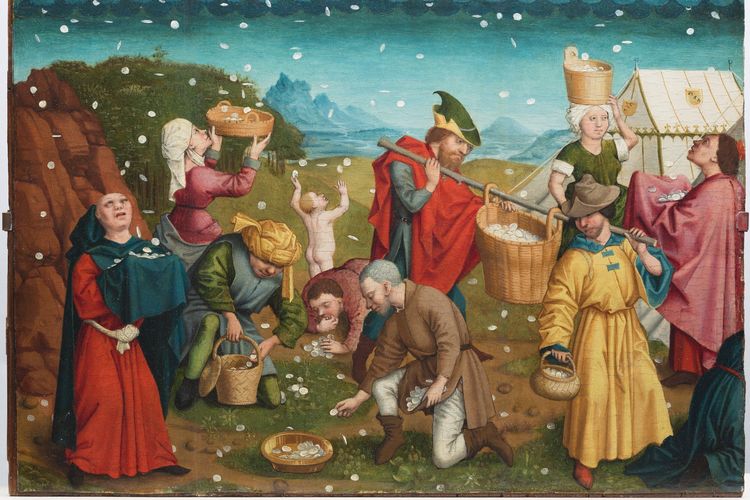
In the evening quails came up and covered the camp; and in the morning there was a layer of dew around the camp. When the layer of dew lifted, there on the surface of the wilderness was a fine flaky substance, as fine as frost on the ground. When the Israelites saw it, they said to one another, “What is it?” For they did not know what it was. Moses said to them, “It is the bread that the LORD has given you to eat”… The house of Israel called it manna; it was like coriander seed, white, and the taste of it was like wafers made with honey.
Exodus 16:13-15, 31
The name itself is telling. The Hebrew man hu (מָן הוּא) is most likely a play on the question “What is it?”, which became the name of the substance itself.5 The people could not classify it by the categories they knew. It was not Egyptian grain stored in Pharaoh’s warehouses. It was not bartered for, purchased, or earned. It simply appeared each morning, spread across the ground like frost, free and available to everyone equally. In an empire, food flows upward to the powerful. In the wilderness, it falls downward from the sky.
The Three Tests
Yahweh attaches three specific instructions to the manna, and each one directly contradicts a habit that imperial life would have ingrained in the people. Together, these instructions form the core of what can be called the Manna Principle.
Gather only what you need
The first instruction is about sufficiency: each person gathers an omer per day, no more and no less, according to the number of people in the household.
This is what the LORD has commanded: ‘Gather as much of it as each of you needs, an omer to a person according to the number of persons, all providing for those in their own tents.'”
Exodus 16:16
Some people gathered more than the prescribed measure, and some gathered less. But when they weighed their portions, a startling equalization occurred.
The Israelites did so, some gathering more, some less. But when they measured it with an omer, those who gathered much had nothing over, and those who gathered little had no shortage.
Exodus 16:17-18
The text does not explain the mechanics of how this equalization happened. What it communicates is the principle: in Yahweh’s economy, provision is measured by need, not by the ability to grab more than others. The competitive scramble for surplus, the engine that drove Pharaoh’s grain monopoly, is rendered pointless. There is enough for everyone, and no advantage in taking more.
Do not hoard
The second instruction addresses the impulse to stockpile. The manna must be consumed the same day it is gathered. Nothing is to be saved overnight.
And Moses said to them, “Let no one leave any of it over until morning.”
Exodus 16:19
Some people disobeyed.
But they did not listen to Moses; some left part of it until morning, and it bred worms and became foul. And Moses was angry with them.
Exodus 16:20
The point is visceral. The manna that is hoarded rots. It breeds worms. The very act of stockpiling, which in an imperial economy is a sign of power and prudence, becomes repulsive and useless under Yahweh’s provision. Hoarding is not merely prohibited; it is rendered materially self-defeating. If the Joseph narrative showed what happens when a ruler centralizes a food supply and leverages it for permanent control, the manna story shows Yahweh designing a provision that makes such centralization impossible.6
Rest on the seventh day
The third instruction introduces a rhythm of rest. On the sixth day, a double portion appears so that no one needs to gather on the seventh day, which Yahweh designates as a Sabbath.
“Six days you shall gather it; but on the seventh day, which is a sabbath, there will be none… The LORD has given you the sabbath, therefore on the sixth day he gives you food for two days; each of you stay where you are; do not leave your place on the seventh day.”
Exodus 16:26, 29
Once again, some people went out to gather on the seventh day. They found nothing.
On the seventh day some of the people went out to gather, and they found none. The LORD said to Moses, “How long will you refuse to keep my commandments and instructions?
Exodus 16:27-28
This is the first appearance of the Sabbath in Israel’s story, and it arrives not as an abstract theological concept but as a practical feature of how food works. The provision itself encodes a weekly pause. In the Egyptian system, labor was relentless and rest was a privilege of the powerful. Here, rest is built into the food supply. It is not optional. It applies to everyone. The next post in this series will explore the full scope of the Sabbath commandment, but its roots begin here, in the daily rhythm of the manna.
Unlearning the Empire

The people fail every test. They try to gather more than they need. They try to hoard. They try to work on the Sabbath. And while those failures may seem disheartening, they make complete sense when you consider where these people have come from. They have spent generations inside a system where food was a lever of power, where scarcity was manufactured to extract compliance, and where rest was something only rulers enjoyed. Imperial habits do not vanish with a single crossing of the sea. They have to be unlearned slowly, through practice, through failure, and through a provision that stubbornly refuses to cooperate with the old patterns.7
That is what makes the manna story more than an ancient curiosity. It reveals what Yahweh is building. In the Joseph story, food moved from the people upward to Pharaoh and was redistributed as a tool of domination. In the manna story, food moves from Yahweh downward to the people and is distributed as a practice of equity. The Manna Principle inverts the imperial model at every point: where empire centralizes, the manna disperses. Where empire hoards, the manna spoils if stored. Where empire demands ceaseless labor, the manna enforces rest.
Food, in Yahweh’s community, is not meant to be a weapon. It is not meant to create leverage. It is provision for shared need, daily and sufficient, with enough for everyone and no advantage in accumulating more. In a world where hundreds of millions still go hungry while more than a billion tonnes of food are wasted each year, that ancient principle still has something uncomfortable and clarifying to say.
Looking Ahead
The Manna Principle is the first of several concrete practices Yahweh builds into the life of the alternative community. The weekly Sabbath rest, introduced here in seed form, will grow into one of the most radical social laws of the ancient world: a day of equality that extends to children, workers, strangers, and animals. The Sabbath Rest, the Sabbath Year Release, and the Jubilee Year Liberty each build on this same foundation: a society shaped not by the logic of accumulation but by the logic of enough.
Read Next: The Sabbath Rest
Footnotes
- FAO, IFAD, UNICEF, WFP, and WHO, The State of Food Security and Nutrition in the World 2025: Addressing High Food Price Inflation for Food Security and Nutrition (Rome: FAO, 2025). The report estimates that between 638 and 720 million people (approximately 8.2 percent of the global population) faced hunger in 2024. Source. ↩
- United Nations Environment Programme (UNEP), Food Waste Index Report 2024 (Nairobi: UNEP, 2024). The report finds that in 2022, the world wasted 1.05 billion tonnes of food at retail, food service, and household levels, equivalent to approximately one-fifth of all food available to consumers and over one billion meals discarded daily. Source. ↩
- On the psychological dynamics of the Israelites’ complaint and their nostalgia for Egypt as a reflection of imperial conditioning, see Terence E. Fretheim, Exodus (Interpretation: A Bible Commentary for Teaching and Preaching; Louisville: John Knox Press, 1991), pp. 177-183. ↩
- The Hebrew verb nasah (נָסָה) means “to test, try, or prove.” See Ludwig Koehler and Walter Baumgartner, The Hebrew and Aramaic Lexicon of the Old Testament (HALOT), s.v. “נסה.” ↩
- The Hebrew man hu (מָן הוּא) is widely understood as a popular etymology. The ancient versions render the phrase as “What is it?” (see the Vulgate: “Manhu, quod interpretatur, quid est hoc?”). Some scholars note that man may reflect an Aramaic interrogative rather than standard Hebrew. See Brevard S. Childs, The Book of Exodus: A Critical, Theological Commentary (Old Testament Library; Louisville: Westminster John Knox Press, 1974), pp. 282-284; also John I. Durham, Exodus (Word Biblical Commentary 3; Waco: Word Books, 1987), p. 225. ↩
- Walter Brueggemann reads the manna narrative as a direct counter to Pharaoh’s food monopoly in Genesis 47 and the broader economics of empire. See Walter Brueggemann, “The Liturgy of Abundance, the Myth of Scarcity,” The Christian Century 116, no. 10 (March 24-31, 1999): 342-347. ↩
- On the wilderness period as a sustained process of de-imperializing Israel’s consciousness, see Walter Brueggemann, The Prophetic Imagination, 2nd ed. (Minneapolis: Fortress Press, 2001), pp. 7-19; and Terence E. Fretheim, Exodus (Interpretation), pp. 177-190. ↩