
Theme Text
Savage wolves will come in among you. Even from your own number men will arise and distort the truth in order to draw away disciples after them. (Acts 20:29-30)
We studied about God Almighty and Jesus Christ, and explored questions on Co-Equality and Co-Eternity. We learnt about the Holy Spirit too. And we did find the straightforward non-conflicting meaning of John 1:1. We also investigated curious cases like a Fourteenity. Now let us read some history on how and when the concept of a Trinity entered Christian beliefs.
1) The Gnostic Denials of Jesus’ Sonhood & John’s Response
- Christianity was not a new religion that brought along new Gods. Jesus founded it as an extension of the Jewish faith, worshipping the same God of Israel. As a matter of fact, the early Christian Churches worshipped the singular Jewish God and believed in Jesus as the Son, a separate being.
- During the 1st century, Gnostics began to spread a theory that Jesus was just a man possessed for a time by the Christ and that the Christ did not die on the cross. This went against the core Christian truth. So John responded with strong warnings in 1John 1:2-3, 4:1-3, 2John 1:7.
- John’s writings, when read with the background of the Gnostic theories, take on a fresh meaning. He forcefully reiterated that the very Jesus ‘which we have heard, which we have seen with our eyes, which we have looked at, and our hands have touched’ (1John 1:1) was the very Word who was with the Father from the beginning, the agent of all His creative work. And he did suffer and die on the cross for our sins. John was an eye witness.
2) John’s Response Distorted by People Gradually Equating Jesus with God
- After John died, gnostic groups got more powerful, putting pressure on Christians. To contend with them, Christians had to stress the heavenly origins of Jesus, the very Son of God.
- Day by day, a larger and larger image of him was put forward, over-stating his stature beyond that defined in the scriptures.
- By the 3rd century, flawed views like Sabellius’ were proposed, claiming Jesus was an expression of God, and not a separate mighty being. This was widely rejected at first.
3) The Rift: Original Faithful Believers vs New Co-Equality Theorists
- The new theories equating Jesus to God were in stark contradiction to the assertion of the early Church fathers that he was a subordinate Son.
- Those who kept the original faith moved to a devoted defense. The great Arian controversy broke out and a fissure cracked open among Christians.
4) Political Influence & the Formation of the Semi-Trinitarian Nicene Creed
About this time, in the early 4th century, Constantine became the Roman Emperor. Under his rule, thousands of pagans were ‘converting’ to Christianity, and he saw an urgent need to put an end to the Christian controversies so that his empire’s peace was kept.
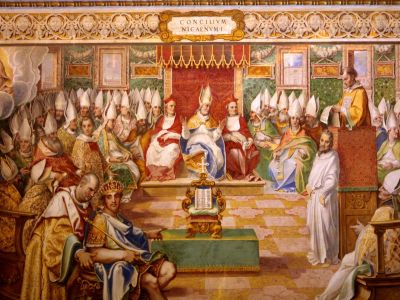
- In 325 AD, he summoned a general council of bishops, the First Council of Nicaea. Debate raged on for months between the new groups who claimed Jesus was equal to the Father and Arius whose followers held that Christ was the Son of God and not God’s equal.
- Some accounts of the heated debate record Arius even being slapped in the face. He maintained that the Son of God was God’s First Production before all ages, and everything else was created through the Son. Thus, said Arius, only the Son was directly created and begotten of God.
- Constantine finally called for a vote of the bishops. The Nicene or Semi-Trinitarian Creed (325 AD), as finally adopted, fixed the doctrine of Christ as ‘God of God, Light of Light, very God of very God…of one substance with the Father.’ This language was not from the Bible, but picked from religious texts of pagans as Constantine wanted to make Christianity more palatable to the pagan masses.
- With the Emperor’s threat of banishment, all but five signed the Creed (CREED, NICENE, McClintock & Strong Cyclopedia). Arius and his followers were deposed and exiled, his writings banned and burnt.
5) The Bridge to Full-blown Trinitarianism – The Nicaeno-Constantinopolitan Creed
- Constantine now had most bishops under his control, and from then on the Church merged with the State. After a tumultuous decade, the Synod of Jerusalem restored Arius to communion, but he died under mysterious circumstances. A couple of monarchs after Constantine were Arian sympathizers, but when Theodosius I ascended the throne, he wiped out Arians through persecution.
- In 381 AD, he called the Second Ecumenical Council. It condemned Arius anew and expanded the Nicene Creed, by elevating the Holy Spirit as ‘the Lord and Giver of life’. This Nicaeno-Constantinopolitan Creed (381 AD) served as a bridge from Semi-Trinitarianism towards full-blown Trinitarianism.
6) The Culmination in Trinitarianism – The Athanasian Creed
- In the 5th century, the Athanasian Creed was put together, declaring that the Holy Spirit too was God, to round off the concept of a Trinity.
- The authors of this Creed had a problem. They had to satisfy the unique faith held by the fathers for thousands of years – ‘The LORD our God, the LORD is one’. How could they make their three Gods into the ancient One?
They came up with this – ‘not three incomprehensibles, nor three uncreated; but one uncreated, and one incomprehensible’. Thus they claimed the One God was actually three Persons.
And they themselves acknowledged this was ‘incomprehensible’.
7) A Summary of History & Facts
To grasp how much change has happened over two thousand years, let us review some facts.
- The word Trinity is not found in the Sciptures. Neither are ‘God the Son’ and ‘God the Spirit’.
- None of the Early Christian Fathers (Ignatius, Clement, Mathetes, Barnabas, Polycarp, Justin Martyr, Papias)wrote about this idea in their 1200 pages of writings.
- All the esteemed early Christian writers (Clement of Alexandria, Arnobius, Irenaeus, Origen, Tertullian, Novatian, Lactantius) were very categorical in asserting that the Father alone is God Almighty and that Jesus is subject to the Father.
- When the word ‘Trinity’ first came along in Christian literature it meant something totally different. It was an idea about the existence of God, his Word, and Wisdom.
- The earliest formal statement of Christian faith never mentions a ‘Trinity’ or any of its notions. It is termed the ‘Apostles’ Creed’ and was used extensively in the 2nd and 3rd centuries.
‘I believe in God, the Father Almighty, Maker of heaven and earth. And in Jesus Christ, his only son our Lord: who was conceived by the holy spirit’.
8) Trinitarian Language Lifted from Pagan/Heathen Sources
The peculiar mystical phrases in the Trinitarian Creeds – ‘one substance of the Father, God of God, Light of Light, very God of very God’ are very alien to the Scriptures. Where do these come from? What’s their source?
The answer is both startling, and chilling.
John Newton (Origin of Triads and Trinities) says,
‘With the first glimpse of a distinct religion and worship among the most ancient races, we find them grouping their gods in triads’.
He goes on to explain the Indian Trinity,
‘The threefold manifestations of the One Supreme Being as Brahma, Vishnu, and Siva was thus sung of by Kalidasa (55 B.C.): ‘In these three persons the One God is shown, Each first in place, each last, not one alone. Of Brahma, Vishnu, Siva, each may be First, second, third among the Blessed Three’’.
On ancient Egypt, Newton quotes Professor Sayce (Gifford Lectures & Hibbert Lectures):
‘The indebtedness of Christian theological theory to ancient Egyptian dogma is nowhere more striking than in the doctrine of the Trinity. The very same terms used of it by Christian theologians meet us again in the inscriptions and papyri of Egypt’.
Newton continues:
‘And now we see some meaning in the strange phrases that have puzzled so many generations in the Nicene and Athanasian Creeds, such as ‘Light of Light, Very God of Very God, Begotten not Made, Being of one Substance with the Father.’ These are all understandable enough if translated into the language of the Solar Trinity [worshipped in ancient Egypt], but without this clue to their meaning, they become sheer nonsense or contradictions…The simplicity and symmetry of the old sun Trinities were utterly lost in forming these new Christian Creeds on the old Pagan models…The [pagan] trinities had all the prestige of a vast antiquity and universal adoption, and could not be ignored. The Gentile converts therefore eagerly accepted the Trinity compromise, and the Church baptized it. Now at length we know its origin’.
Yes, parts of the Nicene and Athanasian Creeds were plagiarized from pagan religious texts – word for word, phrase for phrase!





_-_James_Tissot.jpg)
